Onomatopoeia: Meaning, Definition & 50+ Examples
You’ve heard “buzz,” “meow,” and “boom” your entire life without ever thinking twice about them. But there’s actually a name for this kind of word — one that’s famously tricky to spell and even trickier to pronounce on the first try: onomatopoeia.
If you’ve ever typed “onamonapias,” “onomonopia,” or some other near-miss into Google trying to find this word, you’re in good company. It’s one of the most commonly misspelled terms in the English language, largely because the spelling doesn’t match how most people expect it to sound.
This guide breaks down exactly what onomatopoeia means, where the word comes from, how to pronounce and spell it correctly, and dozens of real examples you’ll recognize instantly.
What Is Onomatopoeia? Quick Definition
Onomatopoeia (noun): a word that imitates or resembles the actual sound it describes.
In simple terms, an onomatopoeia is a word that sounds like the thing it’s naming. When you read it, you can almost hear the sound in your head — that’s the entire point of the device. Words like “buzz,” “hiss,” “crash,” and “meow” don’t just describe sounds; they mimic them.
| Element | Detail |
|---|---|
| Part of speech | Noun (the term) / adjective form: onomatopoeic |
| Pronunciation | on-uh-mat-uh-PEE-uh |
| Word origin | Greek — onoma (name) + poiein (to make) |
| Simple meaning | A word that imitates the sound it refers to |
| Plural form | Onomatopoeias (referring to the individual words themselves) |
How to Pronounce and Spell Onomatopoeia
This word trips people up more than almost any other in English, and it’s easy to see why — the spelling has very little connection to how it sounds when spoken aloud.
Pronunciation: on-uh-mat-uh-PEE-uh
Common misspellings people search for:
- Onamonapia
- Onomonopia
- Onomatopia
- Onamatopeia
- Onomatopeia (missing one “o”)
A simple trick to remember the spelling: break it into three familiar chunks — “onoma” (like “name”), “topo” (think “topic”), and “eia” at the end. Saying it slowly, syllable by syllable, also helps when writing it out.
Where Does the Word “Onomatopoeia” Come From?
The word has Greek roots, formed by combining two words:
- Onoma — meaning “name”
- Poiein — meaning “to make” (this is also where the word “poet” comes from)
Put together, the term essentially means “the making of a name” — in other words, creating a word by imitating a sound. The word entered the English language in the 1500s, though the practice of forming words from sounds is likely as old as language itself.
Interestingly, some 18th-century scholars, including Jean-Jacques Rousseau, once proposed that human language itself originated from onomatopoeia — theories that later picked up nicknames like the “bow-wow theory” and “ding-dong theory.” While these ideas have since been largely dismissed by linguists, they highlight just how central sound-imitation has always been to how humans communicate.
How Onomatopoeia Works
Unlike most words, where the sound of the word has no real connection to its meaning, onomatopoeic words are built specifically so that pronouncing them recreates the sound they describe. Say the word “hiss” out loud, and you’re literally making a hissing sound. Say “buzz,” and your lips vibrate the same way a buzzing insect would sound.
This direct link between sound and meaning is what makes onomatopoeia such a powerful tool in writing — it lets readers hear a scene rather than just picture it.
Compare these two sentences:
- “The wind blew across the field.”
- “The wind howled, hissed, and whooshed across the field.”
The second sentence uses onomatopoeia to turn a flat description into something readers can almost hear, adding rhythm, energy, and atmosphere to the writing.
Types of Onomatopoeia (With Examples)
Onomatopoeic words generally fall into a few recognizable categories. Here’s a breakdown of the most common types, along with examples for each.
1. Animal Sounds
- Meow (cat)
- Woof / Bark (dog)
- Moo (cow)
- Oink (pig)
- Quack (duck)
- Hiss (snake)
- Chirp (bird)
- Neigh (horse)
- Growl (bear, dog)
- Buzz (bee, insect)
2. Human Sounds
- Gasp
- Sigh
- Cough
- Sniff
- Giggle
- Whisper
- Mumble
- Yawn
- Slurp
- Chatter
3. Impact and Action Sounds
- Bang
- Boom
- Crash
- Thud
- Smash
- Clang
- Pow
- Whack
- Bump
- Crack
4. Water and Nature Sounds
- Splash
- Drip
- Gurgle
- Plop
- Trickle
- Ripple
- Whoosh
- Sizzle
- Crackle
- Rustle
5. Mechanical and Everyday Sounds
- Click
- Beep
- Honk
- Vroom
- Tick-tock
- Whirr
- Clank
- Ring
- Buzz (electronics)
- Zip
50+ Common Onomatopoeia Words at a Glance
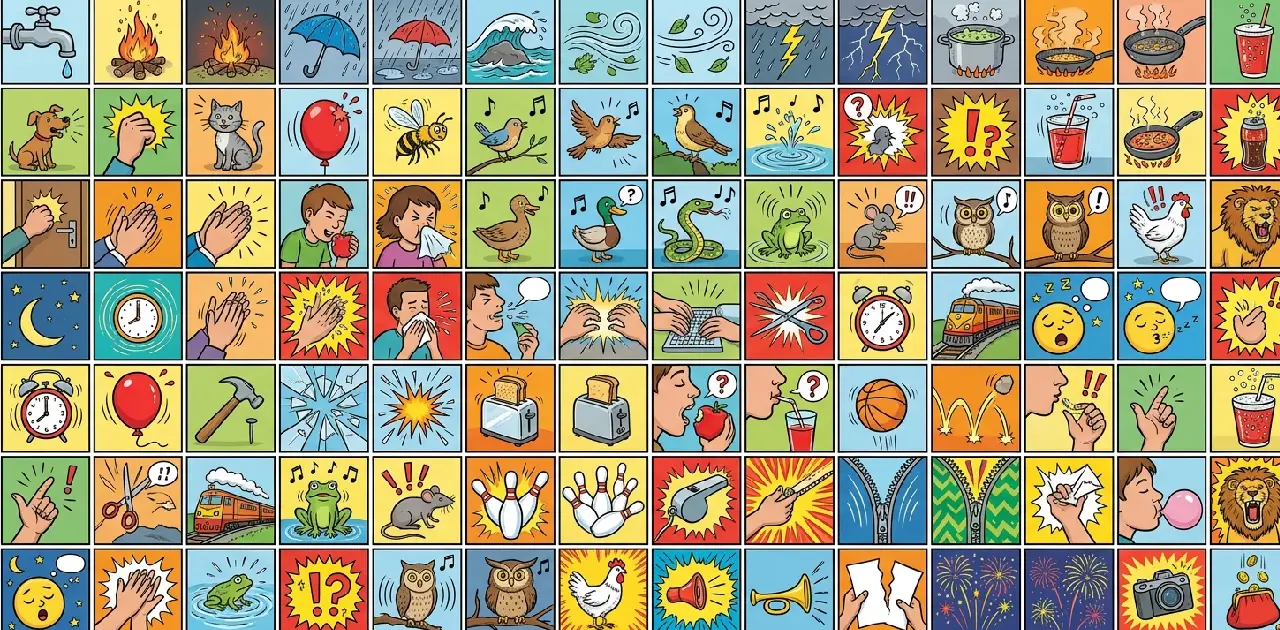
Here’s a quick-reference table grouping frequently used onomatopoeic words by category, useful for writing, teaching, or simply expanding your vocabulary.
| Category | Example Words |
|---|---|
| Animal Sounds | Meow, Woof, Moo, Oink, Quack, Hiss, Chirp, Neigh, Growl, Buzz |
| Human Sounds | Gasp, Sigh, Cough, Sniff, Giggle, Whisper, Mumble, Yawn, Slurp, Chatter |
| Impact Sounds | Bang, Boom, Crash, Thud, Smash, Clang, Pow, Whack, Bump, Crack |
| Water & Nature | Splash, Drip, Gurgle, Plop, Trickle, Ripple, Whoosh, Sizzle, Crackle, Rustle |
| Mechanical/Everyday | Click, Beep, Honk, Vroom, Tick-tock, Whirr, Clank, Ring, Zip, Chime |
Onomatopoeia in a Sentence
Onomatopoeic words are versatile and can function as nouns, verbs, or adjectives depending on how they’re used in a sentence.
As a noun: “The dog let out a bark.”
As a verb: “The dog barked loudly at the mailman.”
As an adjective: “The barking dog kept the neighbors up all night.”
Here are a few more full-sentence examples:
- Bacon sizzled loudly on the pan.
- The tires screeched as the car slammed on its brakes.
- Rain pitter-pattered softly against the window.
- The old floorboards creaked with every step.
- Thunder rumbled in the distance before the storm hit.
Onomatopoeia in Literature and Poetry
Onomatopoeia has been used by writers for centuries to bring scenes to life and give language a rhythmic, musical quality. A famous example comes from Edgar Allan Poe’s poem “The Bells,” which leans heavily on onomatopoeic and sound-mimicking words like “tinkle” and “clang” to recreate the actual sound of ringing bells throughout the poem.
Writers also use onomatopoeia alongside other literary sound devices, such as alliteration, to deepen the sensory effect of a passage. Consider the classic tongue-twister:
“She sells seashells by the seashore.”
The repetition of the “s” and “sh” sounds mimics the sound of ocean waves, even though none of the individual words are strictly onomatopoeic on their own — this shows how sound-based writing techniques often work together.
Onomatopoeia in Comics and Pop Culture
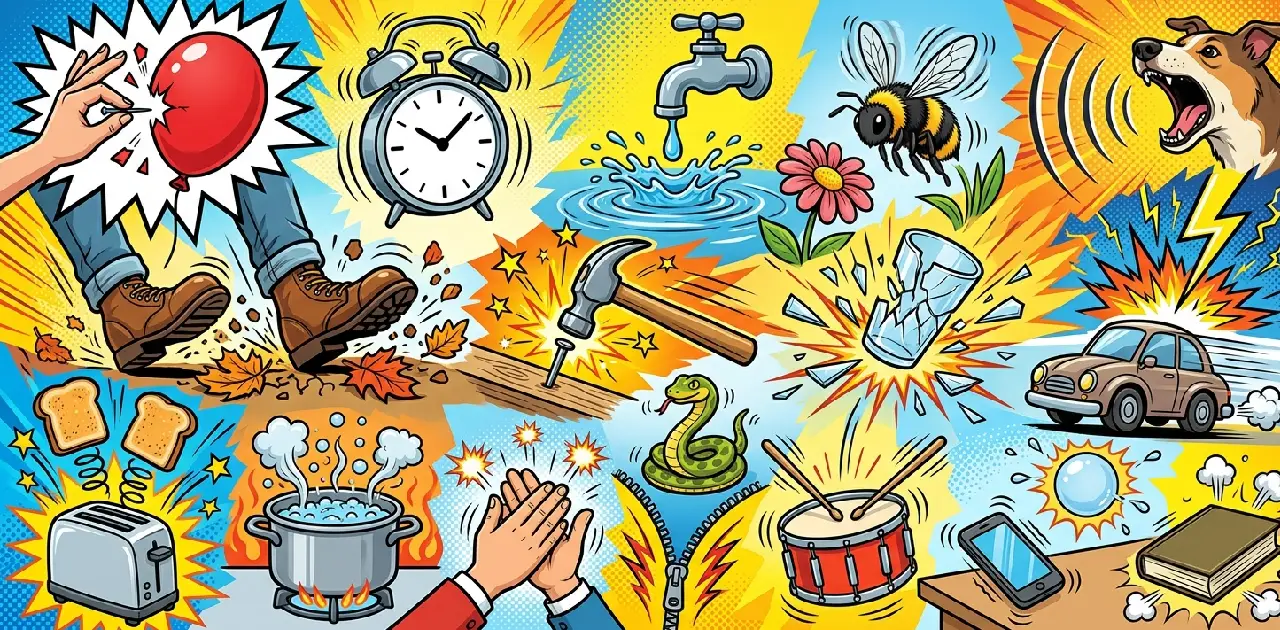
Comic books are one of the most recognizable homes for onomatopoeia. Action scenes are often illustrated with bold, stylized sound words like:
- POW!
- BAM!
- SPLAT!
- ZAP!
- CRASH!
These words don’t just describe an action — they visually and audibly punch up a scene, letting readers “hear” the fight or explosion happening on the page. This same technique carries over into video games, cartoons, and even memes, where sound words are used for comedic or dramatic effect.
Onomatopoeia in Branding and Advertising
Marketers frequently use onomatopoeia because it’s memorable, punchy, and instantly evocative. A well-known example is the Rice Krispies slogan “Snap! Crackle! Pop!” — three onomatopoeic words that describe the exact sound the cereal makes in milk.
Other brand names built on onomatopoeia include:
- Twitter (referencing the chirping sound of birds)
- Slurpee (evoking the sound of drinking through a straw)
- ZipCar (referencing quick, on-demand movement)
Cereal aisles in particular are full of onomatopoeic branding, including names like Cap’n Crunch, Cinnamon Toast Crunch, and Cracklin’ Oat Bran — all chosen because sound-based names tend to stick in people’s memory far more effectively than purely descriptive ones.
Is Every Sound Word an Onomatopoeia?
Not necessarily — and this is a common point of confusion. Some words, like “meow” and “buzz,” are extremely obvious examples because they closely mimic the sound they represent. Others are much subtler, and reasonable people can disagree on whether they truly count.
For example, words like “throb” or “moan” are often labeled onomatopoeic, but the connection between the word’s sound and the actual sound it describes is looser than something like “hiss” or “crash.” There’s no strict scientific test for what officially counts as onomatopoeia — it’s often a matter of degree rather than a clear yes-or-no category.
Onomatopoeia vs. Similar Literary Devices
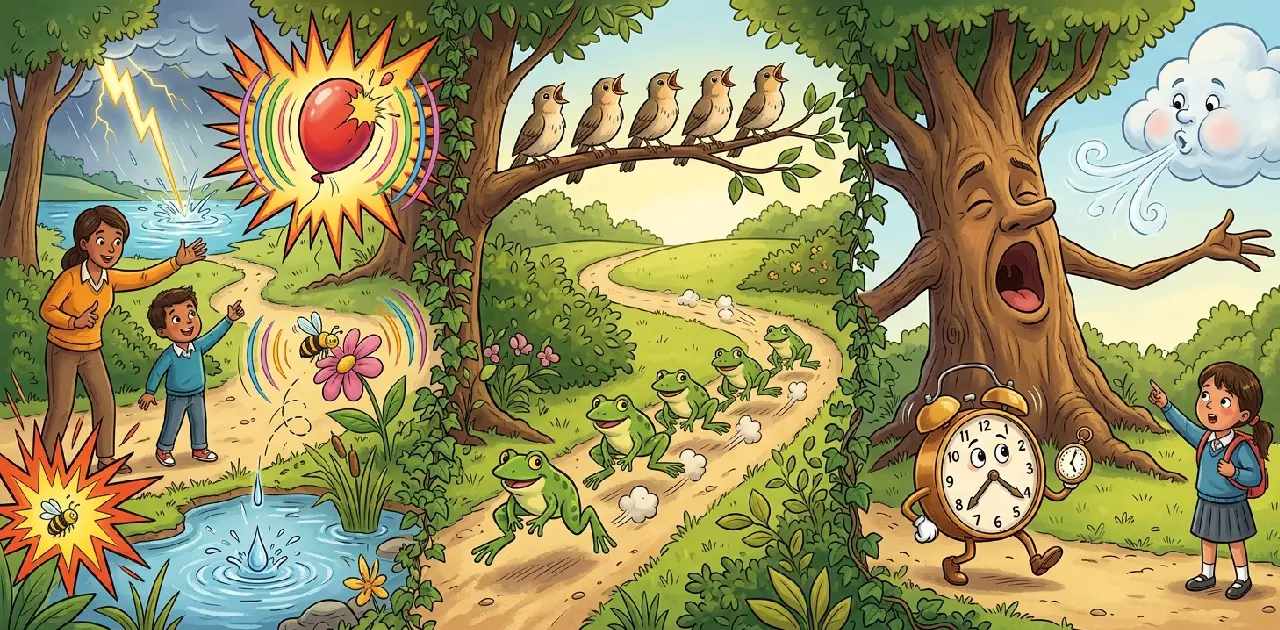
Onomatopoeia is sometimes confused with other sound-based literary techniques. Here’s how it compares.
| Device | Definition | Example |
|---|---|---|
| Onomatopoeia | A word that imitates the sound it describes | Buzz, crash, meow |
| Alliteration | Repetition of the same consonant sound at the start of nearby words | “She sells seashells” |
| Assonance | Repetition of vowel sounds within nearby words | “The rain in Spain” |
| Sibilance | Repeated “s” or “sh” sounds creating a hissing effect | “Silent snakes slither” |
While these devices are all related to the sound of language, onomatopoeia is unique in that the word itself directly represents a real-world sound, rather than simply creating a pattern through repetition.
Why Onomatopoeia Matters in Writing
Onomatopoeia isn’t just a fun vocabulary term — it’s a genuinely useful writing tool. Here’s why writers reach for it so often:
- It creates vivid imagery. Readers don’t just picture a scene; they can almost hear it.
- It adds rhythm and energy. Sound words often carry a natural cadence that flows well in poetry and prose.
- It makes writing more engaging. Onomatopoeia turns flat, generic descriptions into something more immersive.
- It works across formats. From literature to comic books to advertising, onomatopoeia adapts to almost any style of writing.
Conclusion
Onomatopoeia might be one of the hardest words in English to spell, but its meaning is refreshingly simple: it’s just a word that sounds like what it means. From the buzz of a bee to the crash of a wave, these sound-based words show up everywhere — in books, comics, advertisements, and everyday conversation — because they make language more vivid and memorable.
Now that you know where the word comes from, how to pronounce and spell it correctly, and dozens of real examples across different categories, you’ll be able to spot onomatopoeia everywhere you look — and maybe even use a few more of them in your own writing.
FAQs About Onomatopoeia
What does onomatopoeia mean?
It means a word that imitates or resembles the actual sound it describes, like “buzz” or “crash.”
How do you pronounce onomatopoeia?
It’s pronounced “on-uh-mat-uh-PEE-uh.”
What are some common examples of onomatopoeia?
Common examples include buzz, meow, bang, hiss, splash, crackle, and boom.
Where does the word onomatopoeia come from?
It comes from the Greek words “onoma” (name) and “poiein” (to make).
Is “onomatopoeia” also used to describe individual sound words?
Yes, individual sound-imitating words are sometimes called “onomatopoeias” as well.
Can onomatopoeia be used as a verb or adjective?
Yes, words like “bark” can function as a noun, verb (“barked”), or adjective (“barking”).
Why do writers use onomatopoeia?
It makes writing more vivid, engaging, and rhythmic by letting readers hear the sounds being described.
Leave a Reply