

What Does Emphasize Mean? Definition, Uses & Examples
You’ve probably seen “emphasize” in an essay prompt, a work email, or a grammar lesson, and had a rough idea of what it means — but explaining it precisely is a different story. Is it about saying something loudly? Repeating it? Underlining it in a document?
The truth is, “emphasize” covers all three of those, and more. It’s one of those words that shows up constantly in writing, speech, and even design, yet many people use it slightly wrong or confuse it with similar words like “stress,” “highlight,” or “accentuate.”
This guide breaks down exactly what emphasize means, how to use it correctly, where it comes from, and how it’s different from the words people often mistake it for.
Emphasize Meaning: Quick Definition

Emphasize (verb): to give special importance or attention to something, so that it stands out or is clearly understood as significant.
In simpler terms, when you emphasize something, you’re making sure people notice it and take it seriously. That “something” can be:
- A word or phrase you say with extra force
- An idea or point you repeat or highlight in writing
- A feature you draw visual attention to, like bold text or a larger font
- A priority you want a team, reader, or listener to focus on
Here’s the definition broken down for quick reference:
| Element | Detail |
|---|---|
| Part of speech | Verb (transitive) |
| Pronunciation | em-fuh-sahyz (UK: em-fuh-sahyz) |
| British spelling | Emphasise |
| Simple meaning | To stress or highlight the importance of something |
| Word family | Emphasis (noun), Emphatic (adjective), Emphatically (adverb) |
How to Use “Emphasize” in a Sentence
“Emphasize” is a transitive verb, which means it always needs an object — you emphasize something. You’ll typically see it in one of these patterns:
- Emphasize + noun/noun phrase She emphasized the importance of getting enough sleep.
- Emphasize + that-clause He emphasized that the deadline could not be moved.
- Emphasize + how/what/why-clause The report emphasized how little research had been done on the topic.
- It should/must be emphasized that… It should be emphasized that this is only one possible explanation.
Example Sentences Using Emphasize
- The coach emphasized teamwork over individual scoring.
- Her tone emphasized just how serious the situation was.
- The company’s new ad campaign emphasizes sustainability.
- I want to emphasize that this decision wasn’t made lightly.
- Bold text is often used to emphasize key terms in a document.
Where Does “Emphasize” Come From?
Understanding the origin of a word often makes its meaning easier to remember. “Emphasize” comes from the Greek word emphasis, which combines en- (meaning “in”) and phainein (meaning “to show” or “to appear”). Put together, the root idea is something that “shows itself” clearly or stands out.
Over time, this evolved into the Latin and French emphasis, then into English as both a noun (“emphasis”) and, later, the verb form “emphasize.” That’s why the noun and verb are so closely linked — emphasis is the result, and to emphasize is the action of creating that result.
Emphasize vs. Similar Words: What’s the Difference?
This is where a lot of confusion happens. Several words are used almost interchangeably with “emphasize,” but they carry slightly different shades of meaning. Here’s how they compare.
| Word | Core Meaning | Best Used When |
|---|---|---|
| Emphasize | To give importance to something so it’s clearly noticed | General use — spoken, written, or visual |
| Stress | To emphasize with urgency or repetition | You want to underline urgency or necessity |
| Highlight | To draw attention to something, often visually or briefly | Pointing out one detail among many |
| Underline / Underscore | To confirm or reinforce a point that’s already been made | Backing up an existing statement with evidence |
| Accentuate | To make a feature more noticeable, often physical or stylistic | Describing appearance, design, or tone |
| Prioritize | To treat something as more important than other things | Ranking importance among multiple items |
Emphasize vs. Stress
These two are nearly identical in meaning, and in most sentences, you can swap one for the other without changing the meaning. The small difference is tone: “stress” often implies a bit more urgency or repetition, like a parent stressing the importance of safety, while “emphasize” can sound slightly more formal or measured.
Emphasize vs. Highlight
“Highlight” leans more toward the visual and selective — you highlight one part of something to make it stand out from the rest, often briefly. “Emphasize” is broader; it can apply to an entire idea, not just a single detail.
Emphasize vs. Accentuate
“Accentuate” is commonly used for physical or stylistic qualities — a haircut that accentuates someone’s cheekbones, or a dress that accentuates their height. “Emphasize” is more common in the context of ideas, facts, or spoken words.
Synonyms and Antonyms of Emphasize
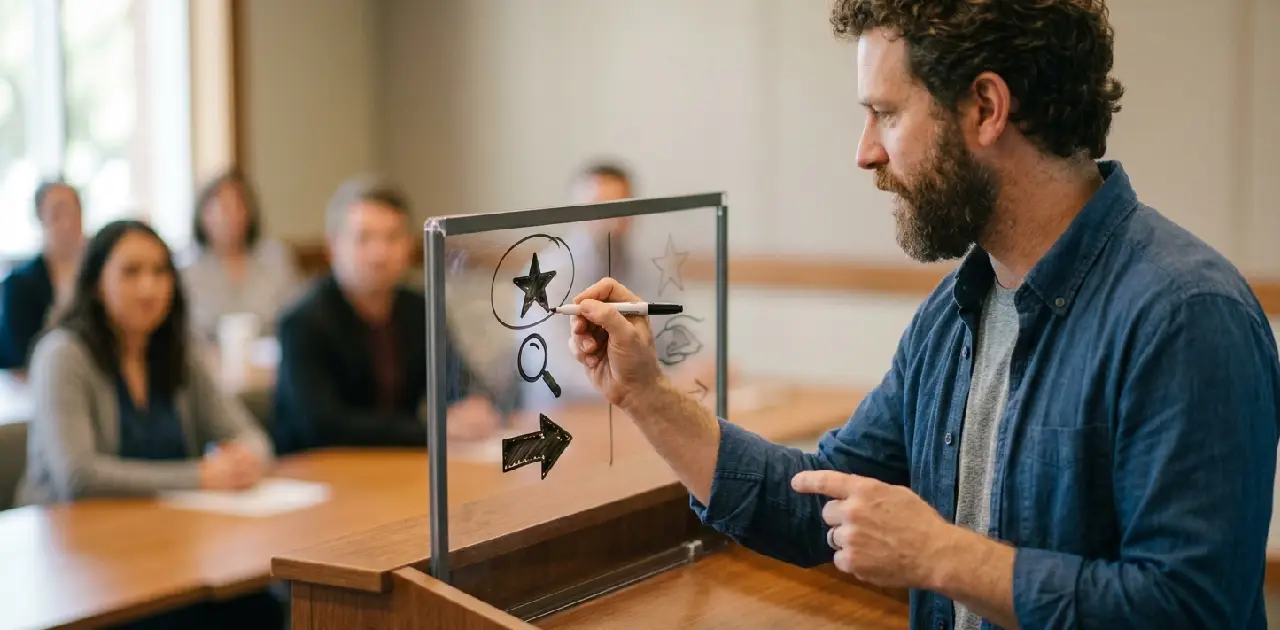
Having a strong list of alternatives helps with both writing variety and understanding shades of meaning.
Common Synonyms
- Stress
- Highlight
- Underscore
- Underline
- Accentuate
- Accent
- Spotlight
- Foreground
- Punctuate
- Feature
- Point up
- Press home
Common Antonyms
- Downplay
- Minimize
- Understate
- De-emphasize
- Play down
- Gloss over
- Soft-pedal
- Disregard
Knowing the antonyms is just as useful as knowing the synonyms — if someone “downplays” a risk instead of emphasizing it, the entire meaning of a sentence flips.
Emphasize as a Noun: Understanding “Emphasis”
Since “emphasize” is a verb, its noun form is “emphasis.” You’ll usually see “emphasis” used in phrases like:
- “Put emphasis on…”
- “There’s a strong emphasis on…”
- “The emphasis of the report was…”
Example: The teacher put a lot of emphasis on grammar this semester.
This is functionally the same idea as “emphasize,” just packaged as a noun instead of a verb. If you’re ever unsure which form to use, remember: emphasis is the thing itself; emphasis is the act of creating it.
Different Contexts Where “Emphasize” Is Used
The word shows up across several very different fields, and the meaning shifts slightly depending on where it’s applied.
1. In Everyday Speech
People emphasize words constantly in conversation, usually by raising their voice, slowing down, or repeating a phrase.
Example: “I said no — I really mean NO.”
2. In Academic and Business Writing
Writers emphasize points using bold text, italics, topic sentences, or repetition of key ideas across paragraphs.
Example: A thesis statement often emphasizes the writer’s main argument before the essay explains it further.
3. In Design and Visual Communication
Designers emphasize elements using size, color, contrast, or placement — think of a bright “Buy Now” button or a bolded price tag.
4. In Music
In sheet music, emphasis (sometimes marked with an accent symbol) tells a musician to play a specific note louder or with more force than the notes around it.
5. In Public Speaking
Speakers emphasize key points through pauses, tone changes, hand gestures, or repeating the phrase differently.
Common Mistakes People Make With “Emphasize”
Even fluent English speakers occasionally trip up on this word. Here are the most frequent errors:
- Using “emphasize on” instead of just “emphasize.” ❌ She emphasized the importance of teamwork. ✅ She emphasized the importance of teamwork. Unlike “focus on” or “insist on,” “emphasize” does not take the preposition “on.” It goes directly before its object.
- Confusing emphasize with emphasis. ❌ He wants to emphasize the deadline. ✅ He wants to emphasize the deadline. Remember: emphasize is the verb, emphasis is the noun.
- Overusing it in writing. Repeating “emphasize” in every paragraph can make writing feel repetitive. Rotating in synonyms like “highlight,” “stress,” or “underscore” keeps the tone varied.
- Mixing up American and British spelling inconsistently. “Emphasize” is standard in American English, while “emphasise” is standard in British English. Pick one spelling and stay consistent throughout a document.
Emphasize vs. Emphasise: American vs. British English
| Version | Region | Example |
|---|---|---|
| Emphasize | American English | I want to emphasize this point. |
| Emphasise | British English | I want to emphasise this point. |
Both are correct — the difference comes down to regional spelling conventions (the same pattern you see with “organize/organise” or “realize/realise”). If you’re writing for a US audience, stick with “-ize.” For a UK, Australian, or broader international audience, “-ise” is more standard.
Quick Reference: Emphasize Word Family

| Word | Part of Speech | Example |
|---|---|---|
| Emphasize | Verb | The report emphasizes the need for reform. |
| Emphasis | Noun | The emphasis of her speech was on kindness. |
| Emphatic | Adjective | He gave an emphatic denial. |
| Emphatically | Adverb | She emphatically refused the offer. |
Conclusion
At its core, “emphasize” simply means to make something stand out as important, whether you’re speaking, writing, designing, or performing music. The tricky part isn’t the definition itself — it’s knowing when to reach for “emphasize” versus a close cousin like “stress,” “highlight,” or “accentuate,” and remembering that it never takes the word “on” after it.
Once you’ve got the grammar pattern down — emphasize plus a noun, a that-clause, or a how/what-clause — using the word correctly becomes second nature. And if you ever want to avoid repeating it too often, you now have a solid list of synonyms to rotate through.
FAQs About the Word “Emphasize”
What does emphasize mean in simple terms?
It means to make something stand out or show that it’s important, whether by repeating it, saying it more forcefully, or highlighting it visually.
Is it correct to say “emphasize on”?
No. “Emphasize” should be followed directly by its object, without “on” — for example, “emphasize the point,” not “emphasize on the point.”
What is the difference between emphasize and emphasis?
“Emphasize” is the verb (the action), while “emphasis” is the noun (the result or the importance being given).
What is a simple synonym for emphasize?
“Stress” is one of the closest and most commonly used synonyms for “emphasize.”
Is “emphasise” a misspelling of “emphasize”?
No, it’s the standard British English spelling, while “emphasize” is standard in American English.
What’s the opposite of emphasize?
Common opposites include “downplay,” “minimize,” and “understate.”
Can “emphasize” be used to describe body language or tone of voice?
Yes — people often emphasize points through tone, pauses, gestures, or facial expressions, not just words.
Leave a Reply