50+ Amazing Phrases With Bunny: Meanings, Origins, and Examples
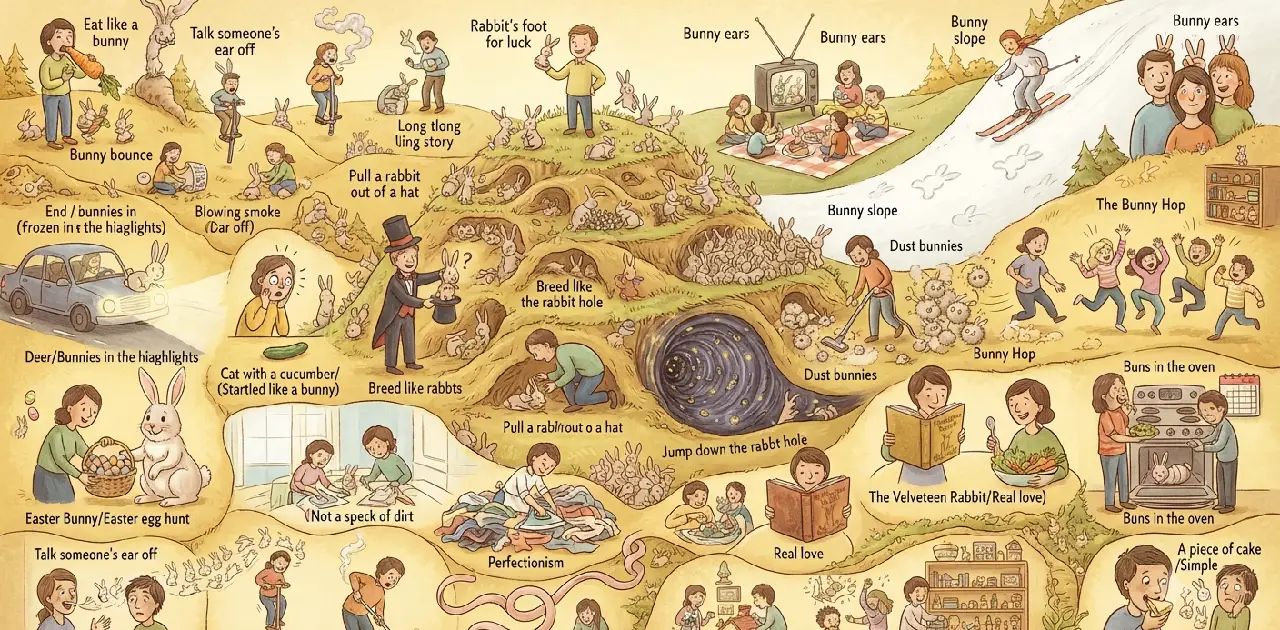
Few animals have hopped their way into everyday English quite like the bunny. From describing someone who’s incredibly fast to expressing affection for a loved one, bunny-related phrases show up far more often than most people realize, often without anyone stopping to think about where they actually came from.
Some of these expressions trace back centuries, while others emerged more recently through pop culture, slang, and shifting social language. What ties them all together is the same set of associations: speed, gentleness, playfulness, and occasionally a bit of unpredictability, all traits people have long linked to rabbits and bunnies in folklore, storytelling, and everyday observation.
This guide breaks down more than 50 phrases with bunny, organized by category, along with clear meanings, real example sentences, and a bit of background on where each one originated. Whether you’re a writer looking to add some color to your language, a student studying English idioms, or just curious about where phrases like “quick as a bunny” or “dust bunny” came from, you’ll find it here.
Why “Bunny” Shows Up So Often in English Phrases
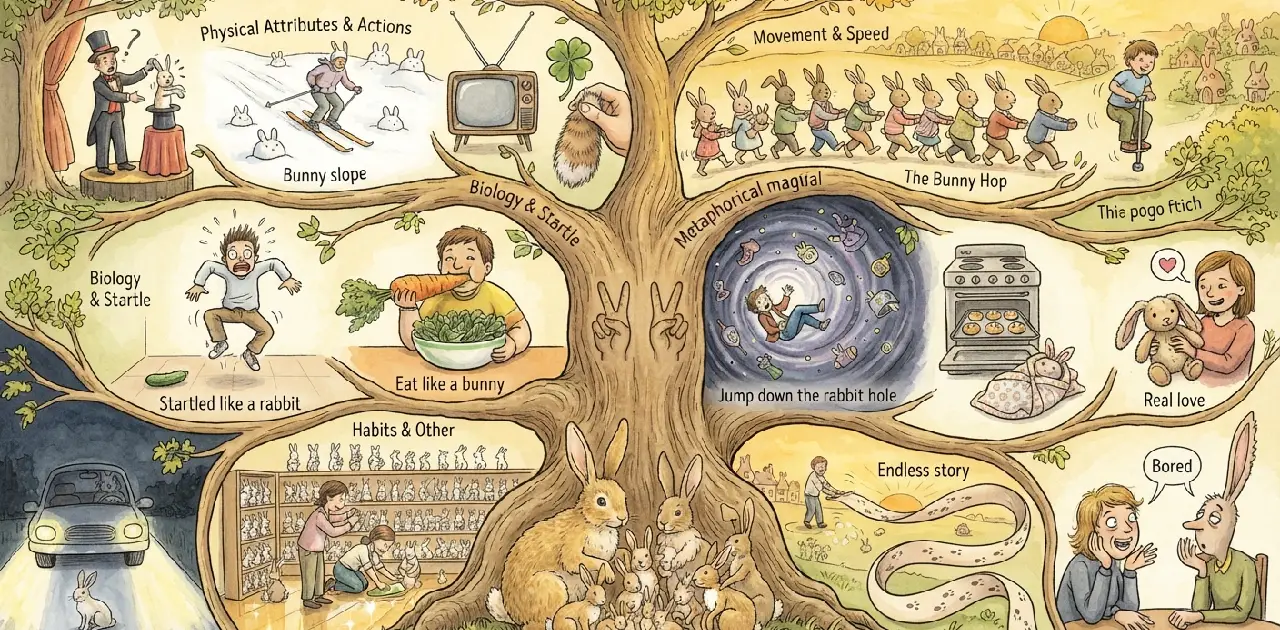
Bunnies have a distinct set of traits that make them a natural fit for idiomatic language. A few reasons this word appears so frequently:
- Bunnies are associated with speed. Their quick, hopping movements naturally lend themselves to phrases about fast action or reaction.
- They’re seen as gentle and endearing. This makes “bunny” a popular term of affection for children, partners, and pets.
- Their behavior inspires visual metaphors. From hopping to freezing in fear, rabbit behavior translates easily into descriptive language.
- “Bunny” feels softer than “rabbit.” As a more childlike, affectionate version of the word, “bunny” often shows up in phrases meant to sound playful or gentle.
- Cultural traditions reinforce the word’s presence. Easter, cartoons, and children’s stories have kept “bunny” firmly embedded in everyday language for generations.
Types of Bunny Phrases: Quick Overview
| Category | Common Theme | Example Phrase |
|---|---|---|
| Speed & Movement | Fast action, quick reactions | Quick as a bunny |
| Emotions & Personality | Mood, fear, or temperament | Not a happy bunny |
| Terms of Affection | Romantic or familial nicknames | Snuggle bunny |
| Everyday & Pop Culture | Common objects, holidays, media | Dust bunny, Easter Bunny |
| Phrases to Use Carefully | Slang with negative or contested meanings | Bunny boiler |
Common Idioms and Phrases With Bunny
Here’s a quick-reference table covering some of the most widely used bunny phrases, their meanings, and how they’re typically used in a sentence.
| Phrase | Meaning | Example Sentence |
|---|---|---|
| Quick as a bunny | Very fast or speedy | She grabbed her keys and was out the door quick as a bunny. |
| Not a happy bunny | Annoyed or unhappy about something | After waiting two hours, he was not a happy bunny. |
| Dust bunny | A small clump of dust and lint, often found under furniture | I found a dust bunny the size of a golf ball under the couch. |
| Snuggle bunny | An affectionate term for a loved one, especially a child or partner | Come here, snuggle bunny, it’s time for bed. |
| Bunny hop | A small hopping movement, often used in dance, cycling, or games | The kids did the bunny hop across the playground. |
| Bunny ears | Fingers held up behind someone’s head in a photo, or a type of antenna | He photobombed the picture with bunny ears behind his sister’s head. |
| Bunny slope | An easy, beginner-level ski slope | We stuck to the bunny slope for our first lesson. |
| Energizer Bunny | Someone with seemingly endless energy | My little brother is like the Energizer Bunny; he never slows down. |
| Bunny boiler | A possessive or obsessive former partner | After the breakup, she turned into a total bunny boiler. |
| Honey bunny | A sweet, affectionate nickname for a loved one | Good morning, honey bunny, I made breakfast. |
Phrases About Speed and Fast Movement
Rabbits are known for their quick, unpredictable movements, and that trait shows up in several common phrases used to describe speed or fast action.
- Quick as a bunny describes someone moving or reacting very fast. This phrase dates back to at least the mid-1800s and has largely replaced older comparisons like “quick as lightning.”
- Bunny hop refers to a small, quick jumping motion, often used in cycling, dance, or children’s games. In cycling specifically, it describes a technique where a rider lifts both wheels off the ground briefly to clear an obstacle.
- Hop to it isn’t exclusively a bunny phrase, but it draws on the same hopping imagery, meaning to start doing something quickly.
- Like a rabbit out of a trap describes someone moving with sudden, explosive speed, often used to describe a fast start in sports or racing.
These phrases work well in both casual conversation and descriptive writing, especially when you want to emphasize speed without repeating the word “fast” too often.
Phrases About Emotions and Personality
Several bunny-related phrases describe someone’s mood, temperament, or emotional state, often in a lighthearted or humorous way.
- Not a happy bunny is a British expression meaning someone is annoyed, frustrated, or unhappy about a situation. It’s typically used in a mild, slightly humorous way rather than to describe serious distress.
- Like a bunny in headlights describes someone who’s frozen with fear, shock, or confusion, unable to react or move. This is closely related to the more common phrase “deer in headlights,” with “bunny” used as a softer or more playful variation.
- Basket case bunny isn’t a widely standardized phrase, but informal variations describing someone as scattered or anxious sometimes borrow bunny imagery for a lighter tone.
- March hare technically refers to hares rather than bunnies specifically, but it’s often grouped with bunny idioms. The phrase “mad as a March hare” describes someone acting wild or erratic, referencing the unusual behavior hares display during their spring breeding season.
These emotional idioms tend to work best in informal writing or conversation, where a bit of playful exaggeration fits naturally. Using “like a bunny in headlights” instead of a plainer phrase like “frozen with fear” adds a visual, slightly humorous texture that can make dialogue or storytelling feel more vivid.
Terms of Affection Using Bunny
“Bunny” has long been used as a gentle, affectionate nickname, especially for children, romantic partners, and pets.
| Term | Typical Use | Tone |
|---|---|---|
| Snuggle bunny | Romantic partner or child | Warm, cozy |
| Honey bunny | Romantic partner | Sweet, playful |
| Sugar bunny | Child or loved one | Cute, gentle |
| Baby bunny | Young child | Tender, soft |
| My little bunny | Child or pet | Affectionate, casual |
These terms tend to work best in close, informal relationships. They’re common in everyday conversation, greeting cards, and casual texting, but they’re rarely used in formal or professional contexts.
Everyday and Pop Culture Bunny Phrases
Beyond idioms in the traditional sense, “bunny” shows up constantly in everyday vocabulary, holiday traditions, and pop culture references. Many of these terms are so common that people rarely stop to think of them as idiomatic at all; they’ve simply become part of standard vocabulary.
- Easter Bunny – The folklore figure associated with Easter who delivers eggs and treats to children, a tradition with roots in German folklore dating back centuries.
- Dust bunny – A small ball of dust, lint, and hair that collects in corners or under furniture.
- Bunny slope – A gentle, beginner-friendly ski or snowboard hill.
- Bunny suit – A protective, full-body coverall often worn in cleanrooms or labs, sometimes also used casually to describe costume-style pajamas.
- Energizer Bunny – Originally a mascot for a battery brand, now used generally to describe someone with unusually high energy or stamina.
- Bunny ears – Either the playful gesture of holding up fingers behind someone’s head in a photo, or a type of indoor television antenna.
- Cottontail – A nickname often used for rabbits with fluffy white tails, sometimes used affectionately for pets or children.
- Bunny costume – A common Halloween or dress-up costume, often associated with cuteness or playful characters.
- Chocolate bunny – A popular Easter treat shaped like a rabbit, often hollow and made of milk chocolate.
- Bunny trail – Occasionally used informally to describe a tangent or distraction in conversation, similar to “going down a rabbit hole.”
Bunny Phrases to Use With Caution
A few bunny-related phrases carry negative, dated, or context-sensitive meanings. It’s worth understanding these before using them, since tone and context matter quite a bit here.
- Bunny boiler refers to a possessive, obsessive, or dangerously fixated former partner. The phrase originated from a well-known 1987 psychological thriller film and has since become widely used in casual conversation, almost always with a negative connotation.
- Gym bunny describes someone, often used somewhat dismissively, who spends excessive time at the gym focused heavily on their physique. Depending on tone, it can be lighthearted or mildly critical.
- Snow bunny has multiple meanings depending on context, most commonly referring to someone, often a beginner, who enjoys skiing or snowboarding purely for the social or aesthetic appeal rather than great skill. Other slang uses of this term exist as well, so context matters significantly.
- Badge bunny is a somewhat dated slang term referring to someone who’s romantically drawn to police officers or law enforcement figures, often used in a mildly mocking tone.
Because tone and regional usage can vary quite a bit with these phrases, it’s worth reading the room before using them in writing or conversation, especially in professional or unfamiliar social settings. When in doubt, sticking to the more universally understood and neutral phrases, like “quick as a bunny” or “dust bunny”, is usually the safer choice for broader audiences.
Bunny Phrases in Literature, Film, and Pop Culture
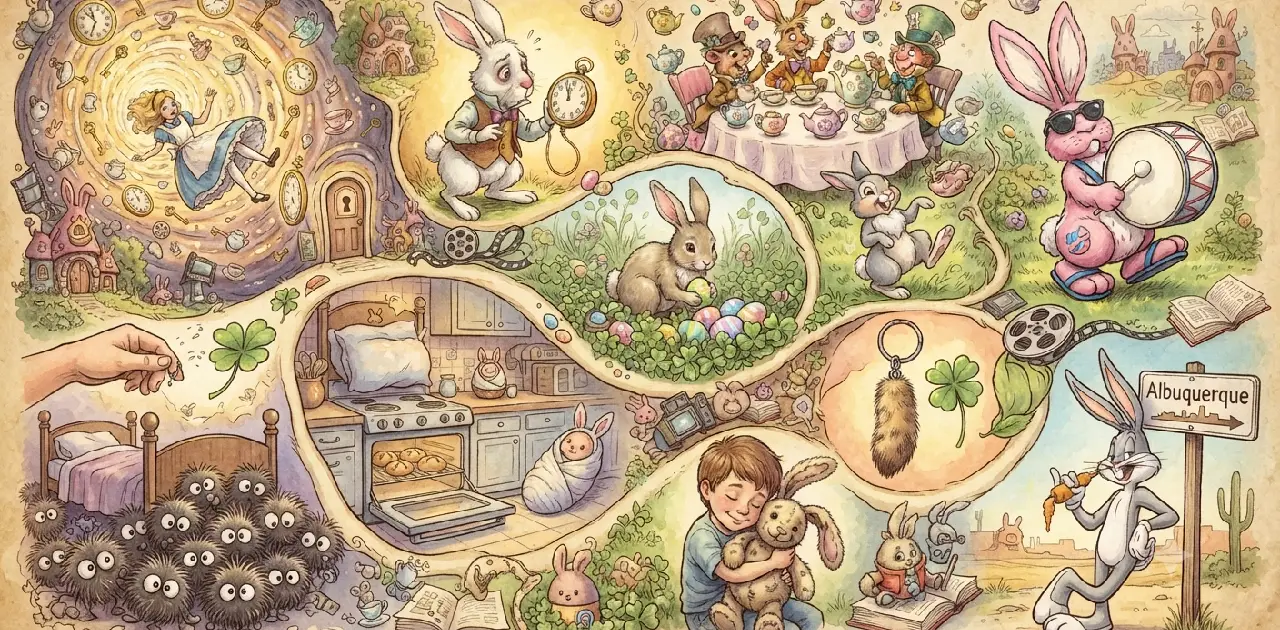
Beyond everyday idioms, “bunny” and rabbit imagery have left a lasting mark on literature and popular media, which has helped reinforce many of these phrases in everyday language.
- “Down the rabbit hole” comes from Lewis Carroll’s classic novel, where the character Alice follows a rabbit into an underground world. Today it’s used broadly to describe getting deeply and often unexpectedly absorbed in a topic, task, or situation.
- Peter Rabbit, the beloved character from Beatrix Potter’s children’s books, helped cement “bunny” as a gentle, endearing figure in Western storytelling, particularly for young children.
- The Velveteen Rabbit, a classic children’s story, contributed to the emotional, sentimental association many people have with bunnies as symbols of love and comfort.
- Bugs Bunny, one of the most recognizable cartoon characters of all time, helped popularize the playful, clever, slightly mischievous personality often associated with rabbits and bunnies in American pop culture.
- Playboy Bunny refers to the hostesses associated with Playboy Clubs starting in the 1960s, a term that became widely recognized in broader pop culture and is sometimes referenced in casual conversation or media even today.
These cultural touchpoints help explain why “bunny” carries such a distinct, recognizable set of connotations: cute, quick, gentle, and occasionally a little mischievous, across so many different phrases and expressions.
Bunny and Rabbit Symbolism Across Cultures
Rabbits and bunnies carry meaning well beyond English-language idioms, and that broader cultural symbolism has influenced how the word gets used in phrases today.
- In Chinese culture, the rabbit is one of the twelve animals of the zodiac, associated with traits like gentleness, elegance, and good fortune. People born in the Year of the Rabbit are traditionally thought to embody these qualities.
- In East Asian folklore, a “moon rabbit” is said to live on the moon, often depicted pounding rice cakes or herbal medicine, a story referenced in various festivals and traditions.
- In Western folklore, rabbits and hares have long been associated with fertility and springtime, which helped shape traditions like the Easter Bunny.
- In some European folk traditions, rabbits were considered lucky, giving rise to customs like carrying a rabbit’s foot for good luck, a practice with roots that predate its more commercialized modern version.
This wide range of symbolism, spanning luck, gentleness, fertility, and trickery, helps explain why “bunny” phrases can carry such different tones depending on context, from warmly affectionate to mildly negative.
How to Use Bunny Phrases in Writing and Conversation
A few tips can help you use these phrases naturally and appropriately, whether you’re writing creatively or just chatting casually.
- Match the tone to your audience. Affectionate terms like “snuggle bunny” work well in casual, close relationships but feel out of place in formal writing.
- Consider regional differences. Phrases like “not a happy bunny” are more common in British English than American English.
- Use idioms to add color, not confusion. If your audience might not recognize a specific phrase, a quick clarifying phrase alongside it can help.
- Be mindful of dated or negative slang. Terms like “bunny boiler” or “badge bunny” carry specific, sometimes unflattering connotations, so use them thoughtfully.
- Lean on speed and movement phrases for descriptive writing. Terms like “quick as a bunny” add personality to writing without overusing generic words like “fast.”
- Read example sentences before using an unfamiliar phrase. Idioms often carry subtle tone differences that aren’t obvious from the definition alone.
Frequently Asked Questions
What does “quick as a bunny” mean?
It means moving or reacting very quickly, a phrase that dates back to at least the mid-1800s and remains common today.
What is a “bunny boiler”?
It’s a slang term for a possessive or obsessive former partner, popularized by a well-known 1987 film and now used broadly in casual conversation.
What does “not a happy bunny” mean?
It’s a mostly British expression meaning someone is annoyed or frustrated about a situation, usually used in a mild, humorous way.
Is “snuggle bunny” a romantic term or a term for kids?
It can be used for both; it’s commonly used as an affectionate nickname for a romantic partner as well as for young children.
Where does the phrase “dust bunny” come from?
It describes the way loose dust and lint clump together into soft, fluffy balls, resembling the shape and texture of a small bunny.
Are bunny phrases mostly used in casual or formal contexts?
Mostly casual, since bunny-related phrases tend to carry a playful, informal tone that doesn’t typically suit professional or formal writing.
What’s the difference between “quick as a bunny” and “quick as a flash”?
Both mean the same thing: very fast, though “quick as a bunny” specifically references the animal’s speed while “quick as a flash” alludes to lightning or light itself.
Where does the phrase “down the rabbit hole” come from?
It originates from Lewis Carroll’s novel “Alice’s Adventures in Wonderland,” where the main character follows a rabbit into a hidden underground world.
Is “bunny” used differently in British English compared to American English?
Somewhat, phrases like “not a happy bunny” are more commonly heard in British English, while terms like “snow bunny” or “gym bunny” appear more frequently in American slang.
What does the rabbit symbolize in the Chinese zodiac?
The rabbit represents gentleness, elegance, and good fortune, and people born in the Year of the Rabbit are traditionally associated with these qualities.
Can bunny phrases be used in professional writing?
Generally no, most bunny-related phrases carry a casual or playful tone that doesn’t suit formal or professional writing, with a few exceptions like well-known idioms such as “down the rabbit hole.”
Final Thoughts
Phrases with bunny have hopped their way into English for good reason; they’re expressive, often playful, and surprisingly versatile across different contexts, from describing speed to expressing affection. Understanding where these phrases come from and how they’re typically used can help you use them more naturally in both writing and everyday conversation.
Whether you’re reaching for “quick as a bunny” to describe someone’s speed or calling a loved one your “honey bunny,” these phrases add a bit of warmth and personality to the language. Keep this list handy next time you want to add a little extra charm to your writing or conversation.
From literature and folklore to modern slang and pop culture, “bunny” has proven to be one of the most versatile animal-based words in the English language. Bookmark this guide, and the next time you reach for a phrase to describe speed, affection, or a cluttered corner of your living room, you’ll have plenty of colorful options ready to go.
Leave a Reply