
Jokes Tagalog With Answers: 150+ Funny Pinoy Q&A Jokes
There’s a very specific kind of joy that comes from a good “jokes tagalog” question-and-answer exchange. Someone throws out a random question, “Ano ang tawag sa pusang sikat?” and before you can even guess, the punchline lands, usually a clever bilingual pun that mixes Tagalog and English into something you didn’t see coming. That’s the heart of Pinoy humor, and it’s exactly why this style of joke has stayed a barkada favorite for generations.
Jokes tagalog with answers work because of Taglish, the natural, everyday blend of Tagalog and English that most Filipinos grow up speaking. That mix gives comedy writers double the wordplay material, a joke can hinge on a Tagalog setup with an English punchline, an animal sound turned into an English word, or a simple homophone that only clicks once you say it out loud.
This guide rounds up the best jokes tagalog with answers, sorted by category, classic “Eh, di” pun jokes, knock-knock jokes, bugtong riddles, school and barkada humor, family and workplace jokes, corny pick-up lines, and tips for telling them well. Whether you’re prepping material for a family reunion or just need something to send in the group chat, you’ll find it below.
Why Jokes Tagalog With Answers Are So Popular
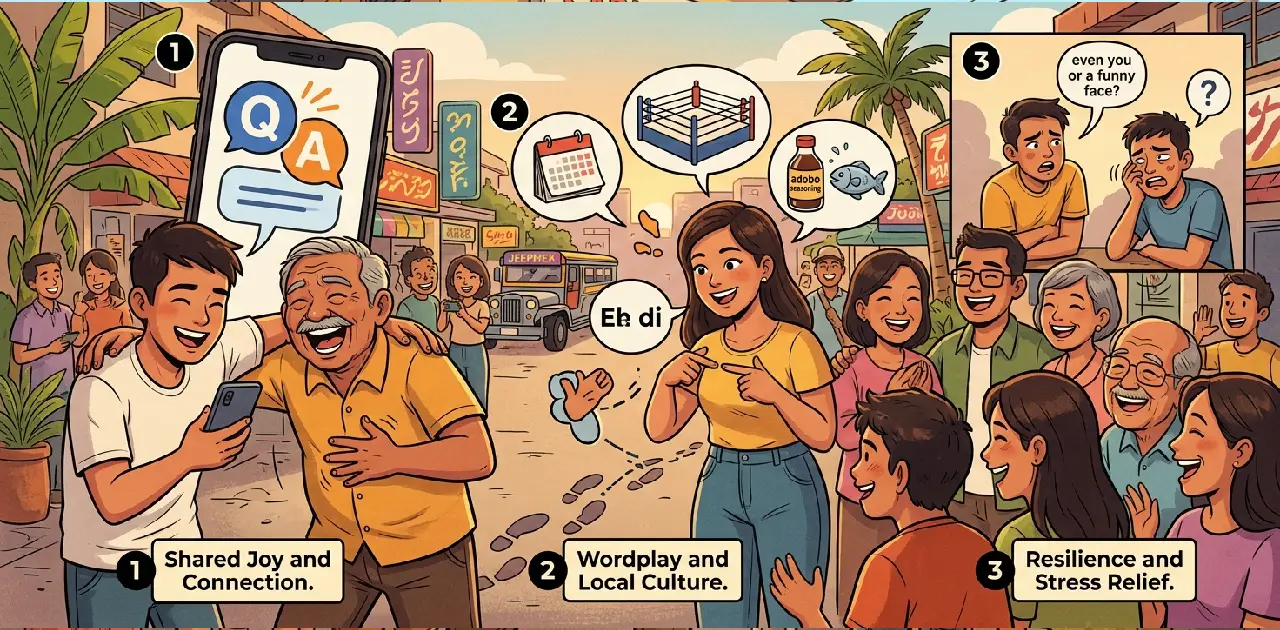
This specific style of humor has stuck around in Filipino culture for a real reason. A few things make it work so consistently:
- Taglish gives it double the wordplay potential. Since most Filipinos naturally code-switch between Tagalog and English, jokes can pull puns from either language, or blend both in a single punchline.
- The question-and-answer format invites participation. Unlike a story-style joke, a Q&A joke pulls the listener in immediately, they’re guessing along before the punchline even lands.
- It’s a genuine oral tradition. Riddle-and-answer humor has deep roots in Filipino culture, long before social media, through the bugtong tradition (more on that below).
- It’s endlessly shareable among barkada. These jokes are built for group settings, parties, reunions, and long tricycle or jeepney rides where everyone’s trying to one-up the last punchline.
- They’re clean and widely appropriate. Most jokes tagalog with answers work fine for kids, lolas, titos, and coworkers alike, making them one of the safest go-to humor styles for mixed company.
- They double as a genuine bonding activity. Guessing together, arguing over whether a pun “counts,” and groaning at a bad answer is part of the shared experience, which makes this format social by nature rather than something told in isolation.
The Classic “Eh, Di” Joke Format, Explained
If you’ve spent any time around Filipino humor, you’ve heard the setup: someone asks a seemingly random question, and the answer always starts with “Eh, di…” followed by a punny, often bilingual answer. This format is one of the most recognizable joke styles in Philippine pop culture, and it usually works one of three ways:
| Pun Style | How It Works | Example Pattern |
|---|---|---|
| Compound word reveal | The answer is an existing English word that fits two meanings at once | Isdang artista → STARFISH |
| Animal sound + English word | An animal’s sound gets merged into an unrelated English word | Baka sa paboritong subject → MOOsic |
| Sound-alike substitution | A Tagalog or English word is swapped for a similar-sounding English word or phrase | Sakit ng manok → CHICKENpox |
Understanding these three patterns makes it much easier to actually build your own jokes tagalog with answers instead of just memorizing a list, and it’s part of why this format has been so easy to keep reinventing for decades.
The Linguistics Behind Why Taglish Jokes Work So Well
It’s worth pausing on why this bilingual joke format works so naturally in the Philippines specifically, and not just because Filipinos happen to speak two languages. Taglish, the everyday blend of Tagalog and English, is what linguists call code-switching, moving fluidly between two languages within the same sentence or conversation, and it’s deeply embedded in Philippine daily life, from casual conversation to television, radio, and social media.
Because code-switching is already such a normal part of how Filipinos communicate, jokes that hop between Tagalog and English don’t feel forced or gimmicky, they feel completely natural. A punchline like “Eh, di STARFISH!” works instantly for a Filipino audience precisely because switching from a Tagalog question into an English answer mirrors exactly how real conversations already flow. This is a big part of why the format has stayed so durable across generations, it’s not really a joke technique layered on top of the language, it’s built directly out of how the language is actually used day to day.
This also explains why the format doesn’t translate cleanly into other bilingual cultures without some adjustment. The specific rhythm of Tagalog-to-English code-switching, dropping into English mid-sentence for emphasis, a punchline, or a specific vocabulary gap, is a pattern unique enough to Philippine Taglish that simply swapping in a different language pair rarely produces the same comedic timing. That’s part of why this joke format reads as distinctly Filipino, even to English speakers who don’t understand every word.
Classic “Eh, Di” Jokes Tagalog With Answers

These are the bread-and-butter jokes of the genre, short, punny, and guaranteed to get at least a groan (in the best way).
- Q: Ano ang tawag sa isdang sikat? A: Eh, di STARFISH!
- Q: Anong subject ang paborito ng baka? A: Eh, di MOOsic!
- Q: Anong sakit ang laging dinadapuan ng manok? A: Eh, di CHICKENpox!
- Q: Anong propesyon ang gusto ng aso pagtanda? A: Eh, di DOGtor!
- Q: Anong pabango ang paborito ng pusa? A: Eh, di PURRfume!
- Q: Anong libro ang binabasa ng pusa sa tindahan? A: Eh, di CATalog!
- Q: Ano ang sinasabi ng palaka kapag tama ang sagot mo? A: TOADally correct!
- Q: Ano ang sinasabi ng oso kapag kulang pa rin? A: “BEARly enough!”
- Q: Anong gamit sa bahay ang may balahibo? A: Eh, di FURniture!
- Q: Anong palabas sa Broadway ang paborito ng baka? A: Eh, di MOOsical!
- Q: Anong trabaho gusto ng aso sa istasyon ng pulis? A: Eh, di PAWlice officer!
- Q: Anong panood sa Netflix ang paborito ng pusa? A: Eh, di MEOWvie!
- Q: Anong subject ang paborito ng ahas? A: Eh, di HISStory!
- Q: Anong klase ang gustong kunin ng bubuyog sa kolehiyo? A: Eh, di BUZZiness class!
- Q: Anong gadget ang paboritong bilhin ng aso? A: Eh, di WOOFer!
- Q: Anong bulaklak ang paborito ng araw? A: Eh, di SUNFLOWER!
- Q: Anong prutas ang tumutubo sa lupa pero itlog ang pangalan? A: Eh, di EGGPLANT!
- Q: Anong insekto ang lumilipad papunta sa mantikilya? A: Eh, di BUTTERFLY!
- Q: Anong buwan ang pinakamatamis? A: Eh, di HONEYMOON!
- Q: Anong langaw ang may kasamang apoy? A: Eh, di FIREFLY!
- Q: Anong isda ang matigas ang balat? A: Eh, di SHELLFISH!
- Q: Ano ang tawag kapag nagulo ang zoo dahil sa mga oso? A: Eh, di PANDA-monium!
- Q: Anong pana ang gawa sa ulan? A: Eh, di RAINBOW!
- Q: Anong keyk ang parang plato ang hugis? A: Eh, di PANCAKE!
- Q: Anong sagot ng pusa kapag perfect lahat? A: Eh, di PURRfect!
- Q: Anong tawag sa manukan na may sariling negosyo? A: Eh, di HENterprise!
- Q: Anong paboritong inumin ng multo? A: Eh, di BOO-jito!
- Q: Anong tawag sa asong marunong mag-computer? A: Eh, di TECH-support… ay, DOGtor of IT!
- Q: Anong paboritong dessert ng aso? A: Eh, di POOCH-ie!
- Q: Anong tawag sa manok na sikat sa boksing? A: Eh, di CHICKEN-punch!
- Q: Anong sinasabi ng ibon kapag na-late? A: “TWEET-y sorry, na-traffic ako!”
- Q: Anong paboritong palakasan ng pusa? A: Eh, di CAT-ch, kasi mahilig sila humabol ng laser!
- Q: Anong tawag sa kabayong mahilig mag-Facebook? A: Eh, di HORSE-book!
- Q: Anong paboritong subject ng manok sa school? A: Eh, di EGG-conomics!
Knock-Knock Jokes Tagalog
Knock-knock jokes translate surprisingly well into Taglish, especially when the punchline plays with a Filipino word that sounds like an English phrase or carries a double meaning.
| Setup | Punchline |
|---|---|
| Knock knock. Sino ‘yan? Kamote. | Kamote sino? Kamote ka ba, ang tagal mong nagbukas! |
| Knock knock. Sino ‘yan? Gwapo. | Gwapo sino? Gwapo ka man, wala ka pa ring datung! |
| Knock knock. Sino ‘yan? Tamad. | Tamad sino? Tamad mo namang buksan agad, ang tagal! |
| Knock knock. Sino ‘yan? Lettuce. | Lettuce sino? Lettuce in, ang lamig dito sa labas! |
| Knock knock. Sino ‘yan? Orange. | Orange sino? Orange ka ba masayang makita ako? |
| Knock knock. Sino ‘yan? Utang. | Utang sino? Utang na loob, buksan mo na ‘ko! |
| Knock knock. Sino ‘yan? Bayad. | Bayad sino? Bayad na ‘ko, pasok na ba ako? |
| Knock knock. Sino ‘yan? Trapik. | Trapik sino? Trapik dito sa EDSA, kaya ang tagal ko! |
| Knock knock. Sino ‘yan? Baon. | Baon sino? Baon mo ba ‘ko sa puso mo? |
| Knock knock. Sino ‘yan? Wais. | Wais sino? Wais mo namang tumingin, ako pala ‘to! |
| Knock knock. Sino ‘yan? Lodi. | Lodi sino? Lodi mo dapat ako, ang tagal kong kumatok! |
Bugtong: The Original Filipino Riddle Tradition
Before “jokes tagalog with answers” became a viral internet format, Filipinos already had a rich tradition of riddle-and-answer wordplay called bugtong. Unlike a joke, a bugtong is a genuine riddle, it describes something indirectly using vivid imagery, and the listener has to guess what’s being described.
Bugtong has been part of Filipino oral tradition for generations, passed down through families and communities long before radio, television, or social media existed. It’s often used to teach children observation skills, vocabulary, and cultural values through playful, poetic language, and many bugtong follow a rhyming or rhythmic structure in their original Tagalog form.
A few well-known examples of the format (paraphrased for clarity):
- Bugtong: “Maliit pa si kumpare, marunong nang tumawag.” (Small as it is, it already knows how to call.) Sagot: Relo (a clock or watch)
- Bugtong: “Bahay ni kuting, walang pinto’t bintana.” (Kitten’s house, no doors or windows.) Sagot: Itlog (an egg)
- Bugtong: “Maghapon kong hinintay, sa gabi ko nakita.” (I waited for it all day, only saw it at night.) Sagot: Bituin (a star)
While bugtong and the modern “Eh, di” style jokes are technically different formats, one is a poetic riddle, the other a punny Q&A, they share the same underlying appeal: a question that invites the listener to think, followed by a satisfying reveal. Understanding bugtong gives real cultural context to why Filipinos have such a strong, long-standing affinity for riddle-and-answer humor in the first place.
More Bugtong to Try
Here are a few more traditional-style riddles worth sharing, especially with kids or during a family gathering where everyone takes turns guessing.
- Bugtong: “Dala mo, hindi mo nakikita.” (You carry it, but you never see it.) Sagot: Hininga (breath)
- Bugtong: “Isang balong malalim, puno ng patalim.” (A deep well, full of blades.) Sagot: Bibig (a mouth, referring to teeth)
- Bugtong: “Kahit gaano kalayo ang narating, sa umpisa pa rin nagbabalik.” (No matter how far it travels, it always returns to where it started.) Sagot: Karayom at sinulid (a needle and thread)
- Bugtong: “Apat ang paa, hindi makalakad.” (Four legs, but it can’t walk.) Sagot: Mesa (a table)
School and Barkada Jokes Tagalog
These jokes lean into everyday Filipino school life, classroom banter, and barkada culture, the kind of humor that gets passed around during recess or a jeepney ride home.
- Q: Bakit laging late si Juan sa school? A: Kasi Filipino Time siya mismo, hindi lang oras!
- Q: Bakit umiyak ang guro pagkatapos ng exam? A: Kasi puro “Eh, di ganun” ang sagot ng mga estudyante!
- Q: Anong tawag sa estudyanteng laging umuupo sa likod? A: Eh, di BACKbencher, pero sa Tagalog naman, “tamad-ista!”
- Q: Bakit hindi na-graduate si Pedro sa Math class? A: Kasi lagi siyang nawawala sa PROBLEMA!
- Q: Anong sabi ng guro sa estudyanteng laging tulog sa klase? A: “Gising! Dito ka nag-aaral, hindi nagbabakasyon!”
- Q: Bakit laging maluwag ang uniform ni Ana? A: Kasi sinusukat niya lagi ang “extra large na excuse” para hindi pumasok!
- Q: Anong subject pinaka-ayaw ng barkada? A: Eh, di yung walang RECESS sa schedule!
Everyday Life Jokes Tagalog
These jokes lean into relatable Filipino daily life, traffic, food, family, and the small annoyances everyone recognizes instantly.
- Q: Bakit laging pagod si Tatay pag-uwi galing trabaho? A: Kasi kalaban niya araw-araw ang EDSA traffic!
- Q: Anong paboritong exercise ng mga Pinoy tuwing Christmas? A: Eh, di ang pag-abot ng ulam sa lamesa!
- Q: Bakit hindi na-late si Aling Nena sa palengke? A: Kasi mas maaga pa siya kaysa sa manok!
- Q: Anong sabi ng jeepney driver kapag puno na? A: “Sunod na lang po, kulang pa ‘yang tiis n’yo!”
- Q: Bakit ang taas ng presyo sa tindahan? A: Kasi araw-araw, may bagong “sale” na hindi naman talaga sale!
- Q: Anong sinasabi ng nanay pag ayaw kumain ng anak? A: “May mga bata sa Africa na gustong kumain n’yan!”
- Q: Bakit ang tagal ng byahe papunta sa probinsya? A: Kasi sabay pa sa buong bansang umuwi ng probinsya tuwing Pasko!
- Q: Anong sabi ng tindera sa mamimili na nagtatawad? A: “Ate, wala nang lugi dito, sagad na ‘yang presyo!”
- Q: Bakit lahat halos may kambal na pangalan sa Pilipinas? A: Kasi paborito nating “Junior” at “the Second” araw-araw!
Family and Relationship Jokes Tagalog
Family gatherings and barkada hangouts are basically the natural habitat for this style of joke. These lean into relationships, titos and titas, and the classic Filipino family dynamic everyone recognizes.
- Q: Bakit laging maraming tanong ang mga tita sa reunion? A: Kasi trabaho nila talaga ang mag-interogate, parang detective!
- Q: Anong tawag sa asawang laging tama? A: Eh, di ang misis!
- Q: Bakit ang haba ng grasya bago kumain sa reunion? A: Kasi kasama sa dasal ang buong henealohiya ng pamilya!
- Q: Anong sabi ng lolo tuwing may bagong gadget ang apo? A: “Noong panahon namin, radyo lang sapat na!”
- Q: Bakit hindi na kailangan ng alarm clock sa bahay? A: Kasi may sariling “rooster” na tumatawag: si Nanay tuwing umaga!
- Q: Anong tanong palagi ng mga tita sa pamangkin? A: “Kailan ka na magpapakasal?”
- Q: Bakit hindi pwedeng magtago ng sikreto sa pamilyang Pinoy? A: Kasi may sariling “group chat” na mas mabilis pa sa balita!
- Q: Anong sabi ng mga apo sa lola kapag hindi na-gets ang biro? A: “Lola, sobrang lumang joke na po niyan!”
- Q: Bakit lahat halos may salamin ang mga tito sa reunion? A: Kasi kailangan nilang linawin, “seryoso ba ‘yang biro mo o hindi?”
Corny Pick-Up Lines Tagalog
No roundup of Filipino wordplay would be complete without a nod to the corny pick-up line, or “pambobola,” a close cousin of the Q&A joke that swaps the setup-and-punchline format for a flirty one-liner. These are a staple at parties, in group chats, and honestly, in half the memes shared on Filipino social media.
- “Kung ikaw ay prutas, ikaw ang mansanas ng mata ko.”
- “Sa lahat ng estudyante, ikaw lang ang nakakuha ng perfect score sa puso ko.”
- “Hindi ako pulis, pero ikaw, in-arrest mo ang puso ko.”
- “May sakit ka ba? Kasi wala kang kapareho sa ganda.”
- “Kung ako’y magnanakaw, ang puso mo lang ang gusto kong nakawin.”
- “Ikaw ba ay Wi-Fi? Kasi feel ko may connection tayo.”
- “Ilang beses na kitang na-miss call, pero ngayon lang kita na-miss talaga.”
- “Mahal, kung ikaw ay resulta ng exam, laging perfect score.”
Workplace and Office Jokes Tagalog
Filipino office culture has its own set of relatable jokes, from traffic complaints to endless meetings and the eternal wait for payday.
- Q: Anong tawag sa empleyadong laging late pero maganda ang excuse? A: Eh, di STORYteller!
- Q: Bakit hinihintay na hinihintay ang ika-15 at 30 ng buwan? A: Kasi ‘yun lang ang araw na “financially stable” ang lahat!
- Q: Anong pangarap ng bawat empleyado tuwing Lunes? A: Bumalik na agad sa Biyernes!
- Q: Anong tawag sa meeting na dapat sana email na lang? A: Eh, di TIME-waste-ing!
- Q: Bakit laging may sakit ang katrabaho pag Monday? A: Kasi “Monday-itis” talaga ang kalaban nila!
Where to Use Jokes Tagalog With Answers
Different settings call for slightly different styles of Tagalog humor. Here’s a quick guide to matching the joke to the moment.
| Where to Use Jokes Tagalog With Answers | Where to Use Jokes Tagalog With Answers |
|---|---|
| Where to Use Jokes Tagalog With Answers | Where to Use Jokes Tagalog With Answers |
| Where to Use Jokes Tagalog With Answers | Where to Use Jokes Tagalog With Answers |
| Where to Use Jokes Tagalog With Answers | Where to Use Jokes Tagalog With Answers |
| Where to Use Jokes Tagalog With Answers | Where to Use Jokes Tagalog With Answers |
| Where to Use Jokes Tagalog With Answers | Where to Use Jokes Tagalog With Answers |
| Where to Use Jokes Tagalog With Answers | Where to Use Jokes Tagalog With Answers |
| Where to Use Jokes Tagalog With Answers | Where to Use Jokes Tagalog With Answers |
How Jokes Tagalog With Answers Spread Online Today
While this joke format has roots that go back generations, the internet has given it an entirely new life. Platforms like TikTok, Facebook, and group messaging apps have turned the classic “Eh, di” format into a genuinely viral content style, with creators posting rapid-fire question-and-answer videos that invite viewers to guess the punchline in the comments before the reveal.
This shift has also sped up how quickly new jokes spread and evolve. A single clever “Eh, di” joke can circulate across group chats, comment sections, and reposted memes within days, getting slightly remixed and reworded along the way, the same organic, word-of-mouth spread that used to take weeks or months to happen offline. The Q&A format translates especially well to short-form video, since the pause between question and answer creates natural suspense that keeps viewers watching for the punchline instead of scrolling past.
Because of this, the genre keeps growing rather than staying static. New “Eh, di” jokes, fresh knock-knock setups, and updated takes on classic bugtong-style riddles show up constantly, meaning there’s always new material circulating well beyond whatever list happens to be popular at any given moment.
Why This Format Travels So Well With Overseas Filipinos
There’s another reason this style of humor has such staying power online specifically: it travels exceptionally well for Filipinos living and working abroad. For overseas Filipino workers and their families, a shared “Eh, di” joke or a familiar bugtong riddle in a group chat isn’t just a laugh, it’s a small, immediate connection to home, delivered in a format that doesn’t lose anything in translation the way some humor does across cultures.
That emotional pull is part of why Tagalog joke content performs so consistently well across Filipino diaspora communities on Facebook groups, Viber threads, and messaging apps worldwide. A joke that only takes a few seconds to read can carry a surprising amount of comfort and familiarity for someone far from home, which helps explain why this genre has remained so beloved and widely shared, well beyond just being a quick source of entertainment. Even a single “Eh, di” joke, sent at the right moment in a family group chat spanning several time zones, can spark the exact same laughter and back-and-forth banter as if everyone were still gathered around the same dinner table back home.
Tips for Telling Jokes Tagalog With Answers Well
A joke tagalog can land perfectly with the right delivery and fall completely flat without it. A few tips to keep the humor working:
- Pause before the punchline. The “Eh, di” format depends on a beat of anticipation, rushing straight to the answer kills the comedic timing.
- Say it out loud, not just in your head. Many of these jokes rely on how a word sounds when spoken, not just how it looks written down.
- Know your audience’s Taglish comfort level. Jokes that mix English and Tagalog land best with people who code-switch naturally, adjust accordingly for older relatives or non-Tagalog speakers.
- Don’t over-explain the pun. If you have to break down exactly why it’s funny, the joke has usually already lost its punch.
- Mix formats. Alternating between “Eh, di” jokes, knock-knock jokes, and the occasional bugtong keeps a joke session feeling fresh instead of repetitive.
- Deliver with confidence. These jokes are meant to be a little corny, leaning into that tends to get a better reaction than an apologetic delivery.
- Read the room for pick-up lines specifically. Corny pick-up lines work great in a lighthearted flirty context or among close friends teasing each other, but can land awkwardly if used too seriously or with someone who doesn’t know you well.
- Save the bugtong for a patient audience. Since riddles require real thinking time, they work best in a relaxed setting where people are willing to sit with the question for a moment rather than rushing to the next joke.
A Comparison of Filipino Joke Formats

Since this guide covers several distinct styles, it helps to see them side by side. Here’s how the main formats compare in terms of structure, difficulty, and best use case.
| Format | Structure | Difficulty to Guess | Best For |
|---|---|---|---|
| Eh, di” joke | Tagalog question, English/bilingual punny answer | Low, mostly for the reveal | Quick laughs, group settings |
| Knock-knock joke | Interactive setup and reveal | Low, interactive by design | Kids, casual back-and-forth |
| Bugtong | Poetic, descriptive riddle | Moderate to high, genuine guessing | Classrooms, family bonding, cultural activities |
| Pick-up line | Flirty one-liner, no real “answer” | None, it’s a statement | Texting, flirting, playful teasing |
Knowing these differences helps you pick the right format for the moment, a bugtong genuinely challenges people to think, while an “Eh, di” joke is built purely for a fast, satisfying punchline. Mixing all four formats into a single get-together, a few riddles to open, some knock-knocks to keep energy up, and a handful of classic puns to close, tends to keep a group entertained far longer than sticking to just one style all night.
Frequently Asked Questions
What are jokes tagalog with answers?
Jokes tagalog with answers are Filipino question-and-answer jokes, most commonly following the “Eh, di” format, where a Tagalog question is answered with a punny, often bilingual English word or phrase.
What is the difference between a joke tagalog and a bugtong?
A joke tagalog is typically a punny Q&A meant purely for comedic effect, while a bugtong is a traditional Filipino riddle that describes something poetically for the listener to genuinely guess.
Are jokes tagalog with answers appropriate for kids?
Yes, most follow a clean, family-friendly format, making them a popular choice for classroom activities, family gatherings, and kids’ entertainment.
Why do so many Tagalog jokes mix in English words?
Because most Filipinos naturally speak Taglish, a blend of Tagalog and English, which gives joke writers extra wordplay options by pulling puns from both languages at once.
What’s a good jokes tagalog opener for a group chat?
A short knock-knock joke or a classic “Eh, di” one-liner works well, since both are quick to read and easy for others to jump in and reply to.
How old is the bugtong riddle tradition in the Philippines?
Bugtong has been part of Filipino oral tradition for generations, long predating modern internet joke formats, and continues to be taught to children as a form of cultural heritage.
Are pick-up lines tagalog the same as jokes tagalog with answers?
Not exactly, pick-up lines are flirty one-liners without a real question-and-answer structure, while jokes tagalog with answers follow a genuine setup-and-punchline format.
Can jokes tagalog with answers be used to teach kids Tagalog?
Yes, both bugtong riddles and simple “Eh, di” jokes are commonly used in Filipino classrooms as a fun, low-pressure way to build vocabulary and language skills, since the format naturally encourages children to think about word meanings in both Tagalog and English.
Why do Filipino jokes so often follow a question-and-answer format specifically?
The format likely grew out of the long-standing bugtong riddle tradition, which already trained generations of Filipinos to enjoy a question that builds anticipation before a satisfying reveal.
Final Thoughts
Jokes tagalog with answers prove that a good punchline doesn’t need to be complicated to land, it just needs the right timing, a clever bit of wordplay, and an audience ready to groan and laugh at the same time. Whether you’re pulling from the classic “Eh, di” format, a knock-knock joke, or a genuine bugtong riddle passed down through generations, there’s a Tagalog joke ready for practically any occasion.
So the next time you need to break the ice or liven up the group chat, don’t overthink it. Ask the question, wait for the guesses, and let the punchline do the rest, and don’t be surprised if your barkada asks for more right after.
A Quick Practice Round
Before wrapping up, here’s a short set of jokes to try out on your own barkada, family, or group chat right away. Read the question first, give everyone a few seconds to guess, and then reveal the answer for the full comedic effect.
- Q: Anong tawag sa pusang laging galit? A: Eh, di CATastrophe!
- Q: Anong paboritong isport ng bubuyog? A: Eh, di BUZZketball!
- Q: Anong tawag sa asong artista? A: Eh, di PAWparazzi!
- Q: Anong pinaka-gustong subject ng ibon? A: Eh, di TWEET-erature!
- Q: Anong tawag sa manok na may angking galing sa sayaw? A: Eh, di CHICKEN wing… sa dance floor!
- Q: Anong tawag sa pusang laging may plano? A: Eh, di CATculating!
- Q: Anong paboritong kanta ng ahas sa videoke? A: Eh, di HISS-tory ng pag-ibig!
Once you’ve got a few of these memorized, you’ll find yourself naturally spotting the pattern in everyday words, and before long, you’ll be coming up with your own original “Eh, di” jokes on the spot.
Leave a Reply