

Meaning of NGL: What Does NGL Stand For in Text?
You’re reading a text from a friend, and it starts with “NGL, I actually loved that movie.” Or maybe you saw it in a TikTok caption, or a comment under someone’s photo.
Three letters, no punctuation, and suddenly the whole tone of the message shifts. If you’ve paused wondering exactly what those letters are signaling, you’re picking up on something real — NGL isn’t just filler. It’s doing a specific job in the sentence.
This guide breaks down exactly what NGL means, where it came from, how people use it in real conversations, and how it’s different from the anonymous messaging app that shares the same name.
NGL Meaning: Quick Answer
NGL stands for “Not Gonna Lie.” It’s used right before someone shares an honest opinion, a confession, or a genuine reaction — usually something a little blunt, surprising, or slightly embarrassing to admit.
Think of it as a spoken-language habit translated into text. People say “honestly” or “to be real with you” out loud all the time before sharing something candid. NGL does the same job, just faster to type.
| Detail | Information |
|---|---|
| Full form | Not Gonna Lie |
| Tone | Casual, honest, sometimes blunt |
| Common on | Texting, Instagram, TikTok, Snapchat, X (Twitter) |
| Best used for | Prefacing an honest opinion or confession |
| Not the same as | The NGL anonymous messaging app |
How NGL Is Used in a Sentence

NGL almost always sits at the very start of a sentence, signaling that what follows is the real, unfiltered version of someone’s thoughts. Occasionally, it shows up mid-sentence or at the end for the same effect.
Example Sentences Using NGL
- NGL, that movie was way better than I expected.
- NGL, I completely forgot about your birthday.
- I didn’t like the ending, ngl.
- NGL, this playlist has been on repeat all week.
- That test was harder than I thought, ngl.
In every one of these, NGL is flagging the same thing: this is genuinely how I feel, not a polished or diplomatic version of it.
Where Did “NGL” Come From?
The phrase “not gonna lie” itself has existed in casual spoken English for decades, long before texting shorthand turned it into three letters. As internet chatrooms and early texting culture picked up speed in the early-to-mid 2000s,
users began shortening common conversational phrases to save time — NGL became one of many similar abbreviations, alongside terms like TBH (“to be honest”) and IMO (“in my opinion”).
The abbreviation grew steadily through platforms like early forums, Reddit, and Twitter throughout the 2010s. One particularly notable moment came in 2014,
when a high school football player’s enthusiastic postgame interview — in which he casually dropped the phrase — became a viral meme, giving “not gonna lie” a fresh wave of mainstream online attention.
From there, NGL settled comfortably into everyday internet language, appearing across Instagram captions, TikTok comments, Snapchat messages, and group chats.
By the early 2020s, it had become such a fixture of casual digital communication that an anonymous messaging app was even launched under the same name — though, as covered below, the app and the abbreviation are two completely separate things.
Why Do People Use NGL?
NGL serves a few specific purposes in everyday conversation, and understanding them makes it easier to read the tone behind any message that uses it.
- Signaling honesty upfront. It tells the reader that what comes next is genuine, not sugarcoated.
- Softening a blunt or critical comment. Prefacing a complaint or criticism with NGL can make it feel less harsh, since it frames the statement as vulnerable honesty rather than an attack.
- Admitting something slightly embarrassing. NGL often precedes small confessions people might otherwise hesitate to share.
- Adding a conversational, relatable tone. It mimics how people naturally speak, making text-based conversation feel more personal.
Example of softening a criticism: “NGL, I think the new update actually made the app worse.”
Here, NGL takes some of the edge off a fairly direct opinion, framing it as an honest admission rather than a harsh judgment.
NGL vs. Similar Honesty-Signaling Slang
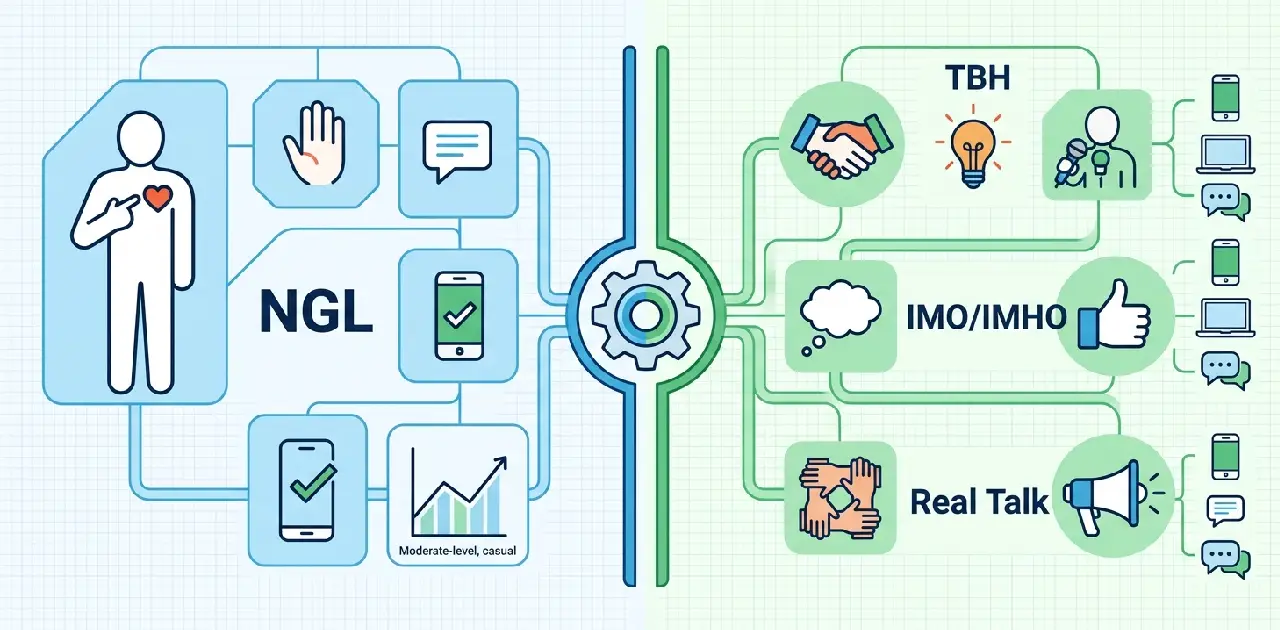
NGL belongs to a small family of abbreviations that all serve a similar purpose — flagging that a statement is genuine — but each carries a slightly different tone.
| Term | Full Meaning | Tone | Typical Use |
|---|---|---|---|
| NGL | Not Gonna Lie | Casual, sometimes blunt | Prefacing an honest opinion or confession |
| TBH | To Be Honest | Slightly more formal-sounding, direct | Sharing a genuine opinion or clarification |
| FR | For Real | Emphatic, intense | Emphasizing sincerity or agreement |
| No Cap | No Lie | Strong emphasis on truthfulness | Asserting something is definitely true |
| Low-Key | Subtly, secretly | Understated, quiet honesty | Admitting a feeling without full commitment |
Key distinction: NGL and TBH are nearly interchangeable in most contexts, but NGL tends to carry a slightly more casual, almost apologetic tone — like the speaker is bracing you for something a little blunt. TBH often reads as more matter-of-fact.
Is NGL Just the Anonymous App?
No — and this is one of the most common points of confusion. While there is a popular anonymous messaging app literally named NGL, launched to let people send and receive anonymous messages and questions, the abbreviation “not gonna lie” existed long before that app and is used completely independently of it.
| The Abbreviation (NGL) | The App (NGL) | |
|---|---|---|
| Meaning | “Not Gonna Lie” | A specific anonymous Q&A app |
| Origin | Early 2000s internet/texting slang | Launched around 2022 |
| Where it’s used | Any text, caption, or comment | Only within the app itself |
| Purpose | Signals honesty before a statement | Lets users send/receive anonymous messages |
If a friend sends you a link asking you to “send them something on NGL,” they’re referring to the app. If someone texts “NGL, I’m not a fan of that show,” they’re using the abbreviation. Context almost always makes the distinction obvious.
NGL Across Different Platforms
While NGL’s core meaning stays the same everywhere, how often it shows up can vary slightly depending on the platform.
| Platform | Typical Use |
|---|---|
| Texting/SMS | Prefacing honest opinions in casual conversation |
| Instagram Captions/Comments | Adding a candid, relatable tone to a post or reply |
| TikTok Comments | Reacting honestly to a video, often paired with humor |
| Snapchat | Common in quick, casual back-and-forth chats |
| X (Twitter) | Used to frame an honest or slightly controversial opinion |
| Influencer/Brand Marketing | Used deliberately to sound more authentic and relatable |
Is NGL Rude?
Generally, no — NGL is considered a neutral to friendly way of introducing an honest statement. That said, tone can shift slightly depending on what follows it:
- Lighthearted honesty: “NGL, I’m obsessed with this song 😂” — reads as fun and genuine.
- Gentle criticism: “NGL, I think you could’ve handled that better.” — softens what might otherwise sound like a harsh comment.
- Blunt or unfiltered: “NGL, that outfit isn’t it.” — can come across as more direct or even a little harsh, depending on the relationship.
In most cases, NGL actually works to soften a statement rather than make it feel more aggressive, since it frames what follows as personal honesty rather than a pointed attack.
How Brands and Influencers Use NGL
Beyond casual texting, NGL has become a deliberate tool in social media marketing. Influencers and brands often use it to make sponsored content or reviews feel more authentic and less like a scripted advertisement.
Example: “NGL, these running shoes have genuinely changed my workouts.”
By opening with NGL, the statement signals sincerity, which tends to build more trust with an audience than a more polished, obviously promotional sentence would.
This tactic works because audiences are generally more receptive to language that mirrors how people actually talk to each other.
Common Mistakes People Make With NGL
A few small misunderstandings show up regularly with this abbreviation:
- Confusing the abbreviation with the app. Since both share the same three letters, context is essential to tell them apart.
- Assuming NGL always signals negativity. While it often precedes a criticism or confession, it’s just as commonly used for positive, enthusiastic opinions.
- Overusing it until it loses meaning. If every sentence starts with “NGL,” the phrase stops signaling anything special and just becomes a verbal tic.
- Using it in overly formal writing. NGL fits casual texting and social media perfectly, but it reads as out of place in professional emails or formal documents.
How to Respond to a Message Starting With NGL
Since NGL usually signals honesty, responding with the same tone tends to work best:
- “Haha fair, I get that.”
- “NGL, same here.”
- “Appreciate you being real with me.”
- If it’s a mild criticism: “That’s fair, I’ll work on that.”
Is NGL Still Used in 2026?

Yes. NGL remains one of the most consistently used honesty-signaling abbreviations across texting and social media. Its staying power comes from solving a genuinely useful communication need — quickly flagging sincerity in a digital space often filled with sarcasm, irony, and curated content.
While internet slang trends come and go quickly, simple, functional phrases like NGL tend to stick around because nearly every generation of texters understands them instantly.
Conclusion
At its core, NGL is a small phrase with a clear job: letting the reader know that what comes next is genuine, unfiltered honesty. Whether it’s used to admit something slightly embarrassing, soften a piece of criticism, or add a more relatable tone to a caption,
its meaning has stayed remarkably consistent since its early internet chatroom days. And while it now shares its name with a popular anonymous messaging app, the two remain entirely separate — one’s a phrase, the other’s a platform.
The next time “NGL” shows up at the start of a message, you’ll know exactly what’s coming: someone’s about to tell you the truth, no sugarcoating required.
FAQs About the Meaning of NGL
What does NGL mean in a text message?
NGL stands for “Not Gonna Lie,” used to preface an honest opinion, confession, or genuine reaction.
Is NGL the same as the anonymous messaging app?
No, the abbreviation predates the app and is used independently in everyday texting and social media.
Is NGL always used for negative opinions?
No, it’s used for both positive and negative honest statements, not just criticism.
What’s the difference between NGL and TBH?
They’re very similar, though NGL often carries a slightly more casual, bracing tone, while TBH feels more matter-of-fact.
Where did the phrase “not gonna lie” originate?
It existed in casual spoken English long before the internet, later becoming a popular texting abbreviation in the early-to-mid 2000s.
Is it okay to use NGL in professional communication?
No, it’s informal slang and best kept to casual texting, social media, and personal conversations.
Is NGL still commonly used today?
Yes, it remains widely used across texting, Instagram, TikTok, and other social platforms.
Leave a Reply