
IMK Meaning in Text: What It Stands For and How to Use It Correctly
You’re scrolling through a text thread, and someone drops “imk” into their message. It’s not a typo you recognize, and it doesn’t quite look like the usual texting shorthand you already know. That small moment of confusion is exactly why so many people search for what IMK actually means before they reply.
This guide breaks down the real meaning behind IMK, where it came from, how it’s used across different platforms, and how it compares to similar phrases like IMO and LMK. By the end, you’ll be able to spot it, use it, and respond to it with total confidence.
Why So Many People Search for “IMK Meaning in Text”
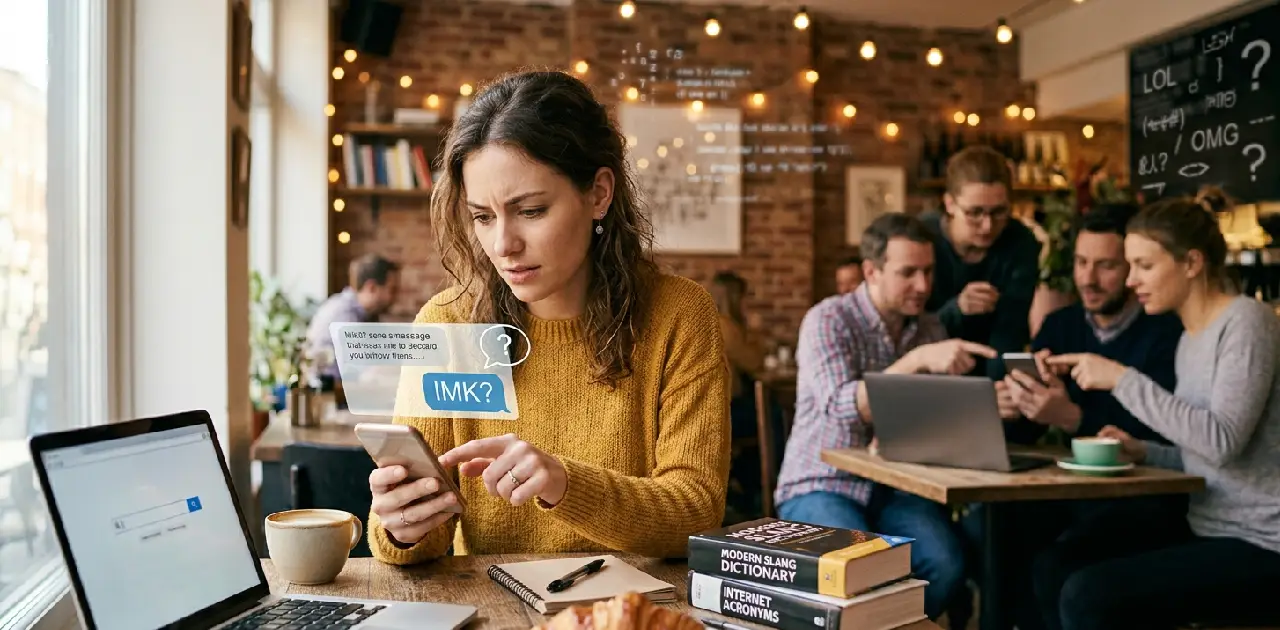
IMK is one of those abbreviations that doesn’t offer any obvious clues about what it stands for. Unlike “brb” or “lol,” which have become so widely used that most people recognize them instantly, IMK is newer, less universal, and easy to mix up with visually similar abbreviations like LMK.
This confusion tends to spike in a few specific situations: when someone receives an unexpected text using the term for the first time, when reading TikTok or Instagram comments filled with unfamiliar shorthand, or when trying to figure out whether a message was a typo for a completely different abbreviation. Because IMK sits in a gray area between “common enough to see regularly” and “rare enough to still confuse people,” it consistently drives people to search for a clear explanation.
What Does IMK Mean?
IMK most commonly stands for “In My Knowledge.” It’s used to share information while being upfront that the person isn’t completely certain about it. Instead of stating something as an absolute fact, IMK signals that the statement is based on what the person currently believes or has heard, not a verified, guaranteed truth.
Functionally, it works almost identically to the phrase “as far as I know.” Both expressions let someone share information honestly while leaving room for the possibility that they could be mistaken or that the details might change.
Here’s a simple example of how it looks in a real conversation:
“Imk the store closes at 9, but you should double check before heading over.”
In that sentence, IMK is doing exactly what “as far as I know” would do; it’s flagging the information as reasonably reliable, but not something the sender is staking their reputation on.
The Other Meaning of IMK: “I’ll Let You Know”
While “In My Knowledge” is the most widely recognized meaning, IMK occasionally shows up with a second, less common definition: “I’ll let you know.” In this usage, the phrase means the person doesn’t have an answer yet but plans to follow up once they do.
Example:
“Not sure if I can make it tonight, imk once I check my schedule.”
This meaning is less universal than “in my knowledge,” and it tends to show up more in casual planning conversations rather than general statements of fact. Because both meanings are used online, context is usually the fastest way to tell which one someone means. If the sentence is sharing information right now, it’s almost always “to my knowledge.” If the sentence is about a future update or answer, it’s more likely “I’ll let you know.”
Where Did IMK Come From?
IMK follows a familiar pattern in internet slang history. It emerged from early chatroom and messaging culture, back when typing full sentences felt slow and clunky compared to shorthand. This same era gave rise to other now-common abbreviations like IMO (“in my opinion”) and IKR (“I know, right?”), All are built around the same idea: compress a common phrase into something faster to type without losing the meaning.
IMK specifically filled a useful gap. “IMO” already existed to soften an opinion, but there wasn’t a widely used shorthand for softening a factual claim in the same way. IMK stepped into that role, giving people a quick way to share information honestly while acknowledging they might not have the full picture.
As texting evolved into social media commenting, DMs, and app-based messaging, IMK carried over naturally. It shows up today across texting, Snapchat, TikTok comments, Instagram DMs, and casual online forums, especially in conversations where someone wants to sound informed without overstating their certainty.
How to Use IMK in a Sentence
IMK typically appears at the start of a sentence, right before the information being shared. This placement gives the reader a heads-up that what follows is based on personal knowledge rather than confirmed fact.
Here are a few natural ways it shows up in conversation:
- “I think the concert got pushed to next month.”
- “I’m not sure she’s not coming to the party anymore.”
- “I’m okay with that restaurant being closed on Mondays.”
- “I think the update fixes the bug, but I haven’t tried it myself.”
- “I’m okay; he already left for the airport.”
In each of these examples, the sentence would still make sense without “imk,” but adding it changes the tone. It shifts the statement from a confident claim to a softened, “this is what I’ve heard” kind of share.
Why People Use IMK Instead of Just Stating Facts

There’s a practical reason IMK has become so popular: it protects the sender from being wrong without making them stay silent. Directly stating something as fact and later being corrected can feel embarrassing or make someone seem unreliable. IMK builds in a small safety net.
This softening effect serves a few specific purposes:
- It signals honesty. The sender is being upfront that they’re not 100% sure, rather than pretending to have complete information.
- It avoids spreading misinformation. By flagging uncertainty, the sender reduces the risk of the listener treating unverified information as confirmed fact.
- It keeps the conversation casual. IMK feels far less formal than saying “to the best of my knowledge,” which can sound stiff in a text conversation.
- It builds trust over time. People who consistently flag uncertain information with IMK tend to come across as more careful and trustworthy than those who state everything as fact.
In short, IMK isn’t just a shortcut; it’s a small but meaningful way of managing how confident a statement should sound.
The Psychology Behind Hedging Language Like IMK
IMK belongs to a broader category of language that linguists sometimes call “hedging,” phrases that soften a statement to reduce the speaker’s commitment to its complete accuracy. Hedging shows up constantly in everyday spoken language too, through phrases like “I think,” “I believe,” or “it seems like.” IMK is essentially a digital, shorthand version of that same instinct.
There’s a genuine social reason hedging language exists at all. Stating something with full confidence and later being proven wrong can feel embarrassing, and it can also make the speaker seem less trustworthy going forward. Hedging protects against that risk. By using a phrase like IMK, the sender preemptively signals, “I’m sharing this in good faith, but don’t hold me fully accountable if it turns out to be inaccurate.”
This same psychological pattern explains why hedging language tends to increase in conversations involving gossip, rumors, or secondhand information. When someone hasn’t directly verified something themselves but still wants to share it, a softening phrase like IMK lets them pass along the information without fully vouching for it.
Generational Differences in Using IMK
Not every generation uses or recognizes IMK the same way. Because it’s a relatively newer piece of internet shorthand compared to older staples like “lol” or “omg,” its usage tends to skew younger.
| Generation | Familiarity With IMK | Typical Usage |
|---|---|---|
| Gen Z | High, widely recognized and used often | Casual texting, social media comments, group chats |
| Younger Millennials | Moderate to high | Comfortable using it, though may default to “afaik” in some cases |
| Older Millennials and Gen X | Lower | May recognize it from context but rarely use it themselves |
| Baby Boomers | Low | Often unfamiliar with the abbreviation entirely |
This generational gap matters most in cross-generational conversations, such as texting a parent, teacher, or older coworker. If you’re not sure whether the other person will recognize the abbreviation, it’s usually safer to spell out “as far as I know” instead.
IMK vs. Similar Slang Terms
IMK belongs to a family of abbreviations that all deal with expressing opinions, certainty, or partial knowledge. While they’re related, each one carries a slightly different meaning and tone.
| Term | Meaning | How It Differs From IMK |
|---|---|---|
| IMO | In my opinion | Expresses a personal viewpoint rather than a fact-based statement |
| IMHO | In my humble opinion | Similar to IMO, but with an added tone of humility |
| AFAIK | As far as I know | Nearly identical in meaning to IMK, often used interchangeably |
| IDK | I don’t know | Expresses a lack of knowledge entirely, rather than partial certainty |
| LMK | Let me know | Asks the other person for information, rather than sharing it |
| TBH | To be honest | Prefaces an honest opinion or admission, not necessarily uncertain information |
| NGL | Not gonna lie | Similar tone to TBH, used before sharing something candid |
The closest match to IMK is AFAIK, since both phrases communicate the exact same idea: sharing something believed to be true without claiming full certainty. IMO and IMHO, by contrast, are reserved for opinions rather than factual claims, which is the key distinction that separates them from IMK.
IMK vs. LMK: A Common Mix-Up

One of the most frequent points of confusion with this abbreviation isn’t about its meaning; it’s about mistaking it for a completely different term. IMK and LMK look similar at a glance, especially when typed quickly or read on a small screen, but they mean very different things.
| Term | Full Meaning | Function in a Sentence |
|---|---|---|
| IMK | In my knowledge | Shares information the sender has, with a note of uncertainty |
| LMK | Let me know | Requests information or a response from the other person |
Example of the difference in context:
“Imk the meeting got moved to 3pm.” (sharing information) “Lmk if the meeting time changes.” (requesting information)
Because these two abbreviations are so easy to mix up, especially when typing fast or dealing with autocorrect, it’s worth double-checking which one you actually meant before hitting send. A simple typo here can flip the entire meaning of a message.
Why the Mix-Up Happens So Often
The confusion between IMK and LMK isn’t really about the words themselves; it’s about how they’re typed and read. Both are three-letter abbreviations, both start with a similar visual shape on a keyboard, and both frequently appear in similar casual texting contexts, like making plans or sharing updates. On a small phone screen, especially when reading quickly or skimming a longer message thread, it’s easy for the eye to slide right past the difference between the “I” and the “L.”
Autocorrect can make this worse rather than better. Some keyboards, especially ones trained on more common phrases, may be more likely to suggest “lmk” simply because it’s more frequently typed, even when the sender meant to type “imk.” This is part of why double-checking a message before sending, especially one using an abbreviation, is a genuinely useful habit.
IMK in Dating and Flirty Conversations
IMK shows up fairly often in dating conversations, usually in a softened, slightly vulnerable way rather than as a straightforward statement of fact. In this context, it works less like “as far as I know” and more like a gentle disclaimer before admitting something personal.
Example:
“Imk, I’ve been kind of into you since we first talked.”
Here, the phrase takes some of the emotional weight off a bold statement. If the feeling isn’t reciprocated, the sender has left themselves a small amount of room, since “imk” softens the certainty of the claim, even though the underlying feeling is genuine.
This flirty usage differs from the standard “sharing unverified information” meaning in one key way: the uncertainty isn’t really about facts; it’s about vulnerability. The person isn’t unsure whether they like the other person; they’re using the phrase to make the admission feel lower-stakes and easier to say out loud, or, in this case, type out.
Because tone matters so much in these situations, the same three letters can come across as playful, nervous, or even a little bit cool and detached, depending on everything else in the conversation. Paying attention to emojis, punctuation, and the overall vibe of the exchange usually makes the intended tone much clearer.
How to Respond to IMK
Since IMK signals a mix of information-sharing and uncertainty, the best response usually depends on how important the information is to you.
| Situation | Suggested Response |
|---|---|
| Casual, low-stakes info (“imk the store closes at 9”) | Okay, thanks for the heads up! |
| Something you need to confirm | Got it, I’ll double check just in case. |
| Conflicting information from another source | Hmm, I heard something different, let me look into it. |
| Uncertain but time-sensitive news | Thanks, keep me posted if you hear anything more solid. |
Because IMK already signals that the information isn’t guaranteed, responding with excessive certainty of your own, like treating it as 100% confirmed, can sometimes lead to miscommunication down the line. A quick acknowledgment that leaves room for updates tends to be the safest approach.
IMK Across Different Platforms
While the core meaning of IMK stays consistent, how frequently it shows up, and in what tone, can shift slightly depending on where you see it.
| Platform | Common Usage |
|---|---|
| Texting (SMS/iMessage) | Common in everyday conversations, especially when sharing secondhand information |
| Snapchat | Used casually in chats, particularly around plans, gossip, or quick updates |
| TikTok | Frequently used in comments and captions, often when sharing opinions framed as loosely known facts |
| Instagram DMs | Common in casual conversations and when discussing uncertain plans |
| Online forums and Reddit-style platforms | Used to soften claims in discussions, especially around debated or unconfirmed topics |
On platforms built around quick reactions, like TikTok comments, IMK often gets used almost like a built-in disclaimer, letting someone share an opinion or rumor without fully committing to its accuracy.
Why IMK Fits TikTok and Comment Culture So Well
Comment sections reward quick, confident-sounding reactions, but they also carry real social risk. Stating something incorrect in a public comment can invite corrections or pushback from other users. IMK gives commenters a way to participate in a discussion, share a take, or pass along information they’ve heard, without fully committing to being right. It’s a small piece of social armor that fits naturally into fast-scrolling, high-visibility platforms.
Why Texting Feels More Personal Than Social Media
Standard text conversations tend to happen between people who already know each other, which changes how “imk” is typically read. In a text from a close friend, the phrase usually feels warm and casual, almost like a verbal shrug. In a comment from a stranger on social media, the same phrase can feel more like a hedge against public criticism. Recognizing this difference helps explain why the exact same abbreviation can feel completely different depending on where it shows up.
How IMK Shows Up in Group Chats
Group chats often involve multiple people relaying secondhand information at once, updates about plans, rumors, or things one person heard from someone else. IMK is especially common in this setting because it lets someone contribute information without becoming the sole source of blame if it later turns out to be wrong. When five different people are sharing bits of information about a schedule change or a piece of gossip, “imk” phrases naturally spread through the thread as a shared way of hedging responsibility.
Is It Rude to Use IMK?
No, IMK is not considered rude. In fact, it tends to come across as the opposite, a considerate way of sharing information without overstating confidence. Because it openly acknowledges uncertainty, it generally reads as honest and low-pressure rather than dismissive or blunt.
That said, tone still matters. In a playful or flirty conversation, “imk” can take on a teasing quality depending on what follows it.
Example:
“Imk, I kind of have a thing for you.”
Here, the phrase softens what might otherwise feel like a bold statement, giving the sender a little emotional cover in case the feeling isn’t mutual. This kind of usage leans more toward playful vulnerability than genuine uncertainty about facts.
When to Avoid Using IMK
While IMK works well in casual digital conversations, there are situations where it’s better left out entirely.
- Professional emails and workplace communication. IMK is far too informal for business correspondence, official reports, or client-facing messages.
- Legal, medical, or safety-related information. In situations where accuracy genuinely matters, spelling out “to the best of my knowledge” or clearly stating uncertainty is safer than shorthand that some readers may not recognize.
- Conversations with people unfamiliar with texting slang. Not everyone knows what IMK means, and using it with someone outside of casual texting culture can create confusion rather than clarity.
- When you’re actually certain about something. If you know something for a fact, using IMK unnecessarily waters down your credibility. Save it for situations where the uncertainty is genuine.
In these cases, taking the extra few seconds to write out a clearer sentence avoids unnecessary confusion.
Common Mistakes People Make With IMK
Even though IMK is a simple abbreviation, a few small missteps can cause confusion or miscommunication.
- Confusing it with LMK. As covered earlier, these two terms look similar but mean opposite things, one shares information, the other requests it.
- Assuming it always means the same thing. While “in my knowledge” is the dominant meaning, some people use IMK to mean “I’ll let you know,” so context always matters.
- Using it in formal writing. IMK has no place in professional emails, academic writing, or anything meant to be read as an official statement.
- Overusing it in every sentence. Attaching IMK to every single statement can make a person sound perpetually unsure of everything they say, even things they’re actually confident about.
- Ignoring the built-in uncertainty. Treating information shared with “imk” as guaranteed fact defeats the entire purpose of the disclaimer. It’s meant to invite a small amount of healthy skepticism.
Being mindful of these small details helps the abbreviation do its job, communicating honestly without creating unnecessary confusion.
Examples of IMK in Real Conversations
Seeing IMK used across a variety of situations makes its flexibility easier to understand.
Example 1 – Sharing a rumor
“Imk they’re breaking up, but don’t quote me on that.”
Example 2 – Casual planning
“Imk the game starts at 7, but I’ll confirm once I check the schedule.”
Example 3 – Group chat update
“Imk practice got cancelled today because of the rain.”
Example 4 – Social media comment
“Imk this actor is actually really down to earth in real life.”
Example 5 – Playful, softened admission
“Imk I might have a small crush on your friend.”
Example 6 – Correcting a misconception
“Imk that’s not actually true, but I could be wrong too.”
Each of these examples shows IMK doing the same basic job, sharing something the sender believes, while leaving a little room for the possibility that they’re mistaken.
A Simple Framework for Deciding When to Use IMK
If you’re unsure whether IMK fits a particular sentence, running through these quick questions can help.
- Am I sharing information I’m not fully certain about? If yes, IMK fits naturally.
- Is this a personal opinion rather than a fact? If yes, IMO or IMHO is a better fit than IMK.
- Am I asking someone else for information? If yes, you likely want LMK instead of IMK.
- Is this conversation formal or professional? If yes, skip the abbreviation entirely and write the full phrase.
- Do I actually know this for certain? If yes, using IMK may undersell your own credibility unnecessarily.
Running through this short checklist takes only a few seconds and helps avoid the most common mix-ups associated with this term.
A Brief Timeline of How IMK Developed
Understanding how IMK fits into the broader history of internet abbreviations helps explain why it feels both familiar and slightly newer than some other common slang terms.
| Era | Development |
|---|---|
| Early 2000s | Chatroom and forum culture popularizes abbreviations like IMO, LOL, and BRB to speed up typing |
| Mid-2000s to 2010s | Texting on early smartphones reinforces the habit of shortening common phrases |
| 2010s | Hedging-style abbreviations like AFAIK gain traction in online discussions and forums |
| Late 2010s to early 2020s | IMK emerges as a shorter, more casual alternative to AFAIK, spreading through texting and social apps |
| Today | Widely used across Snapchat, TikTok comments, Instagram DMs, and everyday texting, particularly among |
This timeline highlights an important pattern: IMK didn’t invent the idea of hedging language online, it simply offered a shorter, catchier way to express something people already wanted to say. That’s a big part of why it caught on as quickly as it did once it started appearing in casual digital conversations.
IMK in Semi-Professional and Gray-Area Contexts

While IMK is firmly casual slang, it occasionally slips into looser workplace communication, particularly in casual team chat tools like Slack, Teams, or Discord among coworkers who already have an informal rapport. Even in these more relaxed professional spaces, it’s worth thinking carefully before using it.
A few reasons to be cautious with IMK at work, even in casual channels:
- It can look unpolished to anyone outside your immediate team, including managers, new hires, or clients who might see the message later or have it forwarded to them.
- It removes clarity from decisions that need to be documented, such as project details, deadlines, or client information, where “to the best of my knowledge” is far clearer than an ambiguous abbreviation.
- Not everyone on a team will recognize it, especially colleagues from different age groups or those less active on social media, which can create unnecessary back-and-forth just to clarify what was meant.
If you want to keep a casual, low-effort tone at work without the ambiguity, spelling out “as far as I know” or “not 100% sure, but I believe” communicates the same idea clearly, without relying on shorthand that not everyone will recognize.
Final Thoughts
IMK stands for “In My Knowledge,” and it’s used to share information honestly while acknowledging that it might not be fully accurate or verified. It functions almost identically to “as far as I know,” giving people a quick, casual way to communicate without overstating their certainty. A secondary, less common meaning, “I’ll let you know,” also shows up occasionally, particularly in planning-related conversations.
What makes IMK genuinely useful, once you understand it, is how much nuance it packs into three letters. It signals honesty, invites healthy skepticism, and softens statements without requiring a long explanation, all while fitting naturally into the fast pace of modern texting and social media.
Whether you’re sharing a rumor, passing along secondhand information, or softening a playful admission, IMK is a small but genuinely useful piece of digital shorthand once you understand how and when to use it. Just remember to double-check it against LMK before you hit send, that one small mix-up is responsible for more confusion than the term itself ever causes.
Frequently Asked Questions
What does IMK mean in a text message?
IMK most commonly stands for “In My Knowledge,” used to share information while acknowledging it might not be fully certain or verified.
Is IMK the same as LMK?
No, IMK means “in my knowledge” and shares information, while LMK means “let me know” and requests information from the other person.
Can IMK mean something other than “in my knowledge”?
Yes, in some cases IMK is used to mean “I’ll let you know,” typically in conversations about future plans or updates.
Is IMK considered rude to use?
No, IMK is generally seen as honest and considerate, since it openly signals uncertainty rather than overstating confidence.
Should I use IMK in professional emails?
No, IMK is casual slang and isn’t appropriate for professional, legal, or formal written communication.
What’s the difference between IMK and IMO?
IMK is used for sharing information with a note of uncertainty, while IMO is used specifically for personal opinions rather than factual claims.
Where did the term IMK originate?
IMK emerged from early internet chatroom culture, following the same shorthand pattern as terms like IMO and IKR.
How do I know which meaning of IMK someone intends?
Context is key. If the sentence shares information right now, it likely means “in my knowledge.” If it refers to a future update, it likely means “I’ll let you know.”
Why do people confuse IMK with LMK so often?
The two abbreviations look visually similar, especially on small screens, and both frequently appear in casual planning conversations, which makes the mix-up common.
Is IMK more popular with younger generations?
Yes, IMK is most widely recognized and used by Gen Z and younger Millennials, while older generations may not be familiar with it at all.
Can IMK be used when I’m actually completely sure about something?
It’s better to avoid it in that case. Using IMK when you’re fully confident can unintentionally undersell your own credibility.
What should I do if I’m not sure whether someone will understand IMK?
When in doubt, spell out “as far as I know” instead, especially in conversations with people outside of casual texting culture.
Does IMK ever get used sarcastically?
Yes, depending on tone and context, IMK can be used sarcastically to poke fun at someone overstating their limited knowledge on a topic.
Leave a Reply