Bad Puns Meaning: Shocking Truth + 60 Funny Examples
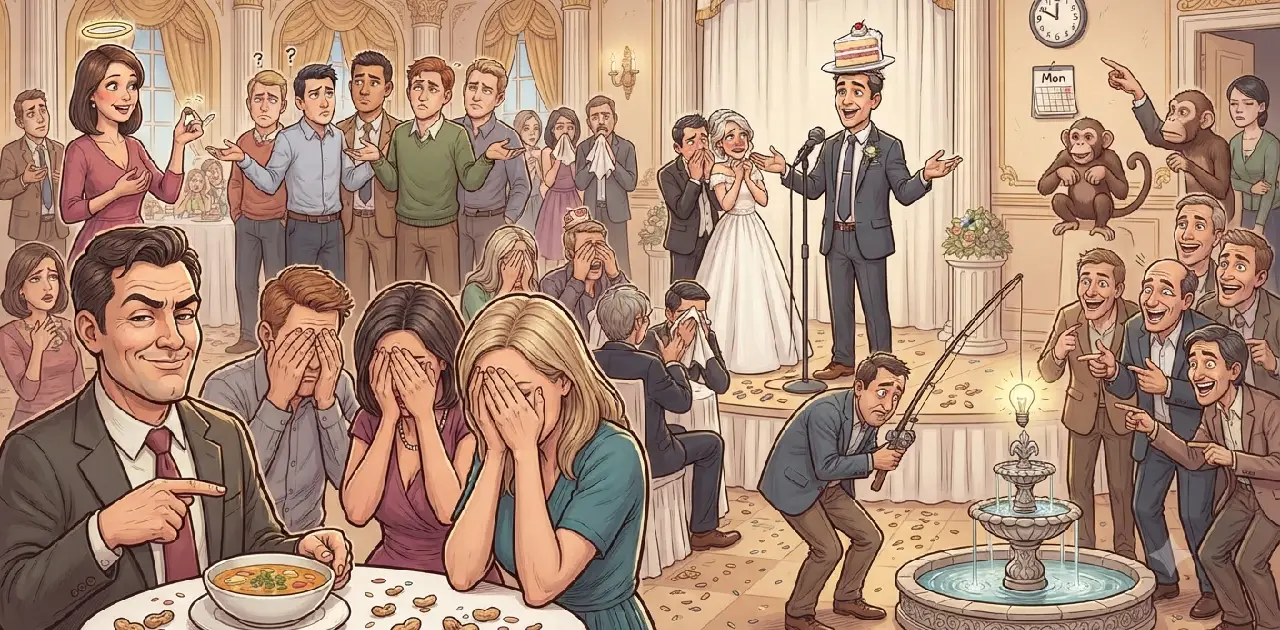
You’ve heard someone tell a pun so cringeworthy that the whole room groaned in unison — and then, half a second later, someone laughed anyway. That contradiction is basically the entire definition of a “bad pun” in one moment.
But what does “bad pun” actually mean, technically speaking? Is it just a joke that fails, or is there something more specific going on linguistically? This guide breaks down the real meaning behind bad puns, why our brains react to them the way they do, the different types you’ll come across, and a long list of examples so you can see the definition in action.
What Is a Bad Pun’s Meaning?
Before getting into what makes a pun “bad,” it helps to nail down what a pun actually is.
A pun is a form of wordplay that uses a word or phrase with multiple meanings, or two words that sound alike but mean different things, to create a humorous or clever effect. The humor comes from the listener mentally holding two meanings at once and noticing the unexpected overlap.
For example: “I used to be a baker, but I couldn’t make enough dough.” The word “dough” works on two levels — the literal bread ingredient and the slang term for money. That double meaning is the pun.
Linguists often break puns into a few core categories:
- Homophonic puns – based on words that sound identical or nearly identical but have different meanings (e.g., “flower” and “flour”).
- Homographic puns – based on words spelled the same but with different meanings or pronunciations (e.g., “I’m reading a book on anti-gravity — it’s impossible to put down”).
- Compound puns – strings together multiple puns in a single joke or sentence.
- Visual puns – rely on an image or symbol rather than spoken wordplay, like a logo that hides a second meaning.
So What Does “Bad Pun” Actually Mean?
Here’s where it gets interesting. In everyday use, calling something a “bad pun” doesn’t usually mean the joke is poorly constructed. It almost always means the opposite — it’s a pun that’s so obvious, so predictable, or so groan-inducing that it becomes funny precisely because of how “bad” it is.
In other words, “bad pun” is a bit of a misnomer. A truly bad pun would be one that simply doesn’t work — the wordplay is unclear, mispronounced, or the audience doesn’t get the reference at all. But when most people say “bad pun,” they mean something more specific:
- The joke is overly obvious. The setup telegraphs the punchline before it arrives.
- It relies on a stretch. The connection between the two meanings is a little forced, which is part of the charm.
- It’s intentionally corny. The teller knows it’s not sophisticated humor, and that self-awareness is part of the joke.
- It causes a groan-laugh reaction. The listener physically reacts with an eye-roll or exaggerated sigh, immediately followed by a real laugh.
So the “bad” in bad pun functions almost like an affectionate insult. It’s shorthand for “this joke is corny, predictable, and I love it anyway.”
Why Do We Laugh at Jokes We Call “Bad”?
This is the part that actually has some science behind it, and it’s more interesting than most people expect.
The Groan-Laugh Response
Psychologists and linguists have studied why puns trigger such a specific, almost involuntary reaction. A few explanations come up consistently:
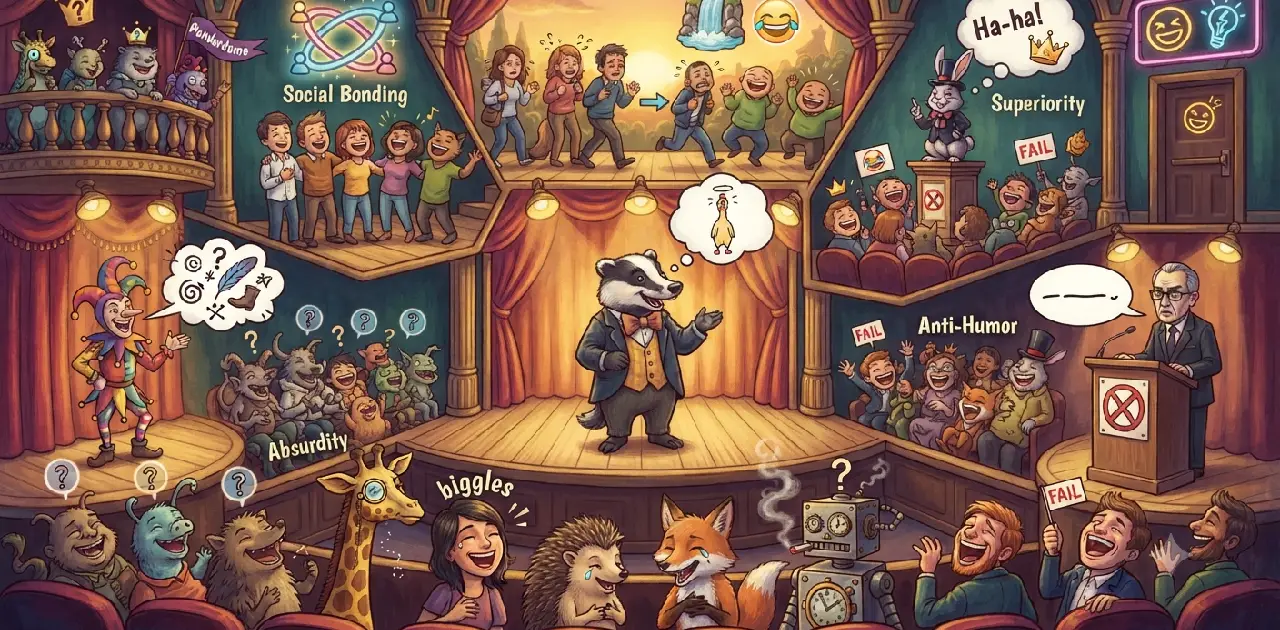
- Dual processing. When you hear a pun, your brain briefly processes two meanings of the same word at once. That mental double-take takes a fraction of a second longer than a normal joke, which creates a small jolt of surprise once you “get it.”
- Benign violation theory. Humor researchers describe jokes as funny when something feels slightly “wrong” (a violation of expectation) but is ultimately harmless (benign). A pun breaks the normal rule that words should only carry one meaning at a time — a tiny, harmless violation that registers as funny.
- Social signaling. Groaning at a pun is often a performance in itself. People exaggerate their annoyance because it’s part of the social ritual of pun-telling — the groan is almost as expected as the laugh.
- Predictability plus payoff. Even when you can see a pun coming, there’s satisfaction in having your prediction confirmed. Your brain enjoys being “right,” even about a corny joke.
Why Some People Love Puns and Others Can’t Stand Them
Not everyone reacts to bad puns the same way, and that’s not just a matter of taste. Research into humor styles suggests that appreciation for wordplay is linked to certain cognitive traits, including how quickly someone processes language and how much they enjoy pattern recognition. People who enjoy solving word puzzles or crosswords, for instance, often gravitate toward puns for the same reason — they like catching the hidden connection.
On the flip side, people who find puns irritating usually aren’t objecting to the wordplay itself. They’re often reacting to the predictability or the interruption a pun causes in a normal conversation. A well-timed pun can feel clever; a poorly timed one can feel like a derailment.
Types of Bad Puns (With Examples)
Not all bad puns are built the same way. Here’s a breakdown of the most common categories, along with examples of each so the definitions actually make sense.
| Type | How It Works | Example |
|---|---|---|
| Homophonic pun | Words sound alike, different meanings | I’m on a seafood diet. I see food, and I eat it. |
| Homographic pun | Same spelling, different meaning | The bicycle couldn’t stand on its own because it was two-tired. |
| Compound pun | Multiple puns stacked in one joke | I used to be a banker, but I lost interest, then I tried baking, but I couldn’t make enough dough. |
| Visual/graphic pun | A picture or symbol implies a second meaning | A gym logo shaped like a dumbbell that also spells “FIT” |
| Recursive pun | A pun that only makes sense after understanding an earlier pun | Long joke chains where each line builds on the last word’s double meaning |
Homophonic Bad Puns
These rely purely on sound. The words don’t need to be spelled the same — they just need to sound close enough that your brain makes the connection.
- I used to be a baker, but I couldn’t make enough dough.
- I’m reading a book about anti-gravity. It’s impossible to put down.
- Time flies like an arrow; fruit flies like a banana.
- I stayed up all night wondering where the sun went. Then it dawned on me.
- The math teacher called in sick with algebra.
Homographic Bad Puns
These use one spelling with two possible meanings, often depending on context or emphasis.
- I’m friends with 25 letters of the alphabet. I don’t know Y.
- A bicycle can’t stand on its own because it’s two-tired.
- When the past, present, and future walked into a bar, things got a little tense.
- A boiled egg every morning is hard to beat.
- Police were called to a daycare because a toddler was resisting a rest.
Compound Bad Puns
These stack multiple wordplays into a single joke, which usually makes the groan even bigger.
- I used to be a florist, but I stopped because I wasn’t growing, and then I tried farming, but nothing panned out.
- I entered ten puns into a contest hoping one would win, but no pun in ten did.
- A perfectionist walked into a bar. Apparently, it wasn’t set high enough.
- I told my computer I needed a break, and now it won’t stop sending me Kit-Kat ads.
- I used to hate facial hair, but then it grew on me.
A Big List of Bad Puns by Category
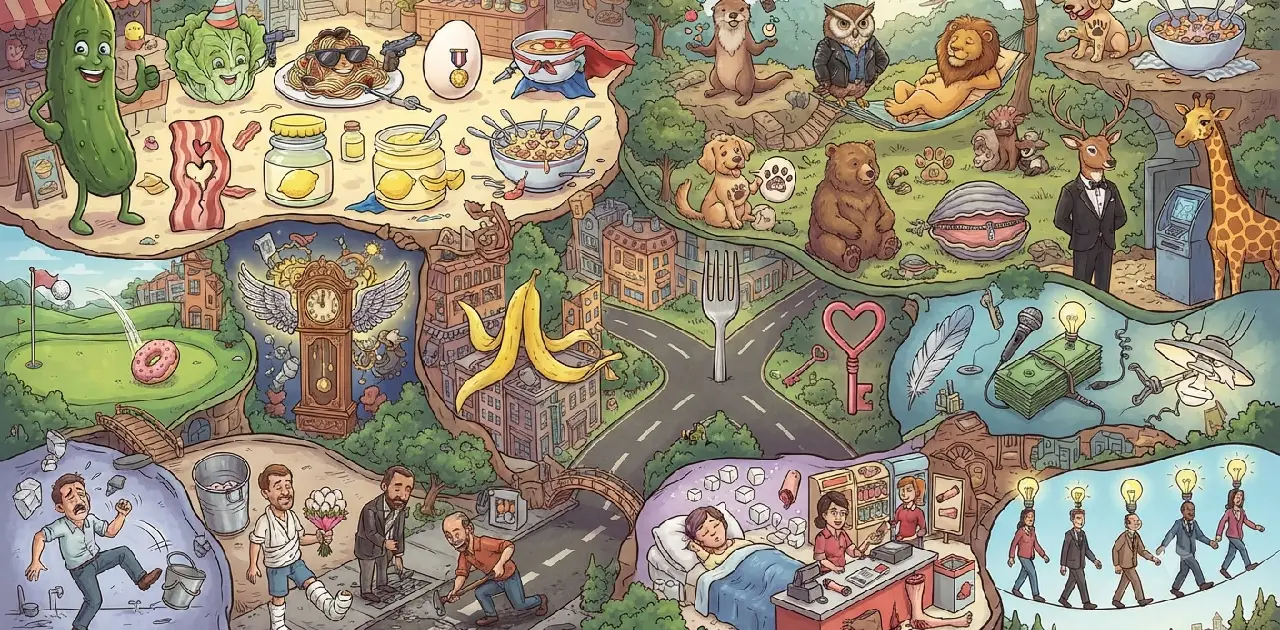
If you want a full range of examples to see the “bad pun” definition in practice, here’s a categorized list.
Food Puns
- Lettuce turnip the beet, it’s time to party.
- I’m reading a book about mushrooms. It’s a real fungi to read.
- Don’t worry, be happy.
- I relish the chance to ketchup with old friends.
- I’m on a roll today — probably because I had bread for breakfast.
Animal Puns
- The owl didn’t want to talk about it because he wasn’t ready to owl-up.
- I told a chicken joke, but it was a little fowl.
- Cats have nine lives, which makes them purr-fect at survival.
- I asked the librarian if they had books on paranoia — she whispered, “they’re right behind you.”
- A snail without a shell is technically homeless, but I’d call it more slug-ish.
Science Puns
- I trust nuclear physicists more than regular physicists; they have more potential.
- I told a chemistry joke, but there was no reaction.
- Geologists don’t die, they just get stoned.
- I’d tell you a chemistry pun, but I know I wouldn’t get a reaction.
- Never trust an atom — they make up everything.
Everyday and Relationship Puns
- I told my wife she should embrace her mistakes. She gave me a hug.
- I asked my dog what’s two minus two — he said nothing.
- I used to have a fear of hurdles, but I got over it.
- My friend’s bakery burned down last night. Now his business is toast.
- I’m reading a horizontal book club — everyone just lies about what they read.
Bad Puns vs. Dad Jokes: What’s the Difference?
People often use “bad pun” and “dad joke” interchangeably, but they’re not exactly the same thing, even though they overlap heavily.
| Feature | Bad Pun | Dad Joke |
|---|---|---|
| Core mechanism | Wordplay based on double meaning | Can be a pun, but also includes simple one-liners without wordplay |
| Typical delivery | Often standalone, quick | Frequently delivered with deadpan timing, sometimes a setup question |
| Goal | Clever double meaning | Intentional corniness, often for comedic groan effect |
| Common source | Comedy writing, wordplay lovers | Associated with parental humor, family settings |
In short: every dad joke that uses wordplay is technically a pun, but not every dad joke relies on a pun. Some dad jokes are just simple, predictable one-liners with no double meaning at all (“What do you call a fish with no eyes? A fsh.”)
Why Bad Puns Are Everywhere in Marketing and Branding
If you’ve noticed pun-heavy names on coffee shops (“Espresso Yourself”), hair salons (“Curl Up and Dye”), or pet stores (“Bark Avenue”), that’s not an accident. Bad puns are a well-known copywriting tool because they’re:
- Memorable. A clever double meaning sticks in someone’s head longer than a plain, literal name.
- Approachable. Puns signal a brand doesn’t take itself too seriously, which can build friendliness and trust.
- Shareable. People love pointing out a good pun to friends, which gives brands free word-of-mouth exposure.
- Easy to localize. Small businesses in particular use local or industry-specific puns to stand out in a crowded market.
This is part of why the “bad pun” reputation persists even in professional settings — marketers intentionally lean into corniness because it works.
How to Tell If a Pun Is “Good Bad” or Just Bad
Not every pun lands the way it’s intended. Here’s a simple way to separate an enjoyably corny pun from one that just falls flat.
- Clarity test: Can most people understand the double meaning within a second or two? If not, it’s not landing as intended.
- Groan factor: Does it get an exaggerated reaction (eye roll, sigh, laugh) rather than confused silence?
- Timing: Is it delivered at a natural pause in conversation, rather than interrupting something serious?
- Originality: Even a classic pun feels fresher with a small twist or unexpected setup.
- Audience fit: A science pun works great with a group of engineers and may fall completely flat elsewhere.
If a pun checks most of these boxes, it’s doing exactly what a “bad pun” is supposed to do — landing as charmingly corny rather than genuinely confusing.
A Brief History of Puns (Why They’re Not a Modern Invention)
Puns aren’t a byproduct of internet culture or dad-joke calendars — they’ve been part of language for thousands of years. Wordplay shows up in ancient Egyptian hieroglyphic writing, biblical texts, and classical Greek and Roman literature, where writers used double meanings for both comedy and serious rhetorical effect.
Shakespeare is probably the most famous historical pun-lover in the English language. His plays are packed with double meanings, from lighthearted jokes to darker wordplay used in tragic moments — proof that puns weren’t always considered “low” humor. In fact, for centuries, punning was viewed as a mark of wit and intelligence, often used by poets, playwrights, and public speakers to show off verbal dexterity.
The shift toward puns being seen as “corny” or “bad” is a relatively modern cultural development. As comedy evolved and observational or narrative humor became more dominant in mainstream entertainment, puns increasingly got labeled as a lower, easier form of joke-telling — even though constructing a good pun actually requires a solid grasp of language, multiple meanings, and timing.
The Linguistics Behind Why Puns Work
Understanding the “meaning” of a bad pun gets a lot clearer once you look at how language itself makes puns possible in the first place.
- Polysemy — when a single word has multiple related meanings (like “bright,” meaning both intelligent and full of light). Puns often exploit polysemy to create a joke with just one word.
- Homophony — when two different words sound the same but have unrelated meanings (like “flower” and “flour”). This is the backbone of most spoken puns.
- Homography — when two words are spelled the same but may be pronounced differently or carry different meanings depending on context (like “tear,” meaning to rip, versus “tear,” meaning a drop from crying).
- Syntactic ambiguity — when a sentence’s structure allows for more than one interpretation, which some more advanced or “compound” puns rely on.
None of this is accidental wordplay — it’s the direct result of how flexible and layered human language actually is. English, in particular, is considered especially pun-friendly because it has borrowed vocabulary from so many different languages, which means there are countless words that sound alike but come from entirely different roots and meanings.
Common Places You’ll Encounter Bad Puns
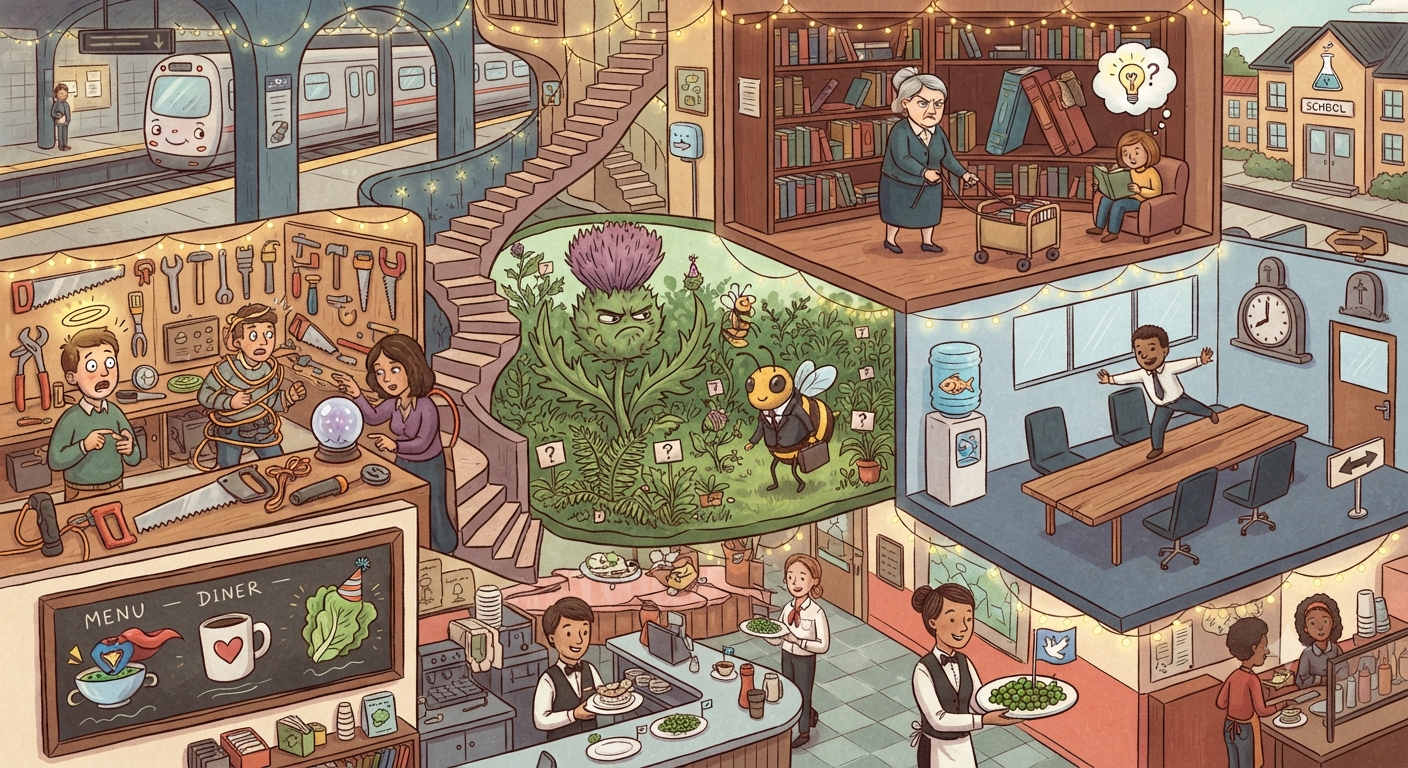
Bad puns aren’t confined to joke books and group chats. Once you start noticing them, they show up almost everywhere:
- Headlines and news articles. Editors love a good pun-based headline, especially for lighter stories (sports, entertainment, and local news are prime territory).
- Product and shop names. From bakeries to hair salons, pun-based branding is one of the most common small-business naming strategies.
- Greeting cards. Birthday, holiday, and get-well cards frequently rely on puns to strike a lighthearted tone.
- Menus. Restaurants and cafes often name dishes or drinks using food-based wordplay to make the menu feel more personable.
- Social media captions. Puns are extremely shareable, which makes them a go-to tool for engagement-focused captions and memes.
- Classroom and workplace humor. Teachers and coworkers often use puns as an easy, low-risk way to lighten the mood without relying on more complicated or risky jokes.
Tips for Writing Your Own Bad Puns
If the appeal of a good “bad pun” has you wanting to write your own, a few techniques can help.
- Start with the punchline word. Pick a word with multiple meanings first, then build the setup sentence backward from there.
- Keep the setup short. The longer the wind-up, the more the payoff has to deliver — simple setups usually land better.
- Read it out loud. Since many puns rely on sound rather than spelling, hearing it will tell you whether the wordplay actually works.
- Don’t over-explain. Part of the fun of a pun is the listener connecting the dots themselves — spelling it out kills the joke.
- Lean into the groan. A confident delivery, paired with a knowing smile, often gets a better reaction than an apologetic one.
- Test it on a small audience first. Puns are highly dependent on shared context and vocabulary, so what lands with one group might completely miss with another.
Frequently Asked Questions
What does “bad pun” mean exactly?
A bad pun usually refers to a pun that’s intentionally corny, obvious, or predictable, causing a groan-and-laugh reaction rather than meaning the joke is poorly made.
Is a bad pun the same as a dad joke?
Not always — most bad puns qualify as dad jokes, but some dad jokes are simple one-liners that don’t use wordplay at all.
Why do bad puns make people groan?
The groan comes from a mix of predictability and mild embarrassment for the joke-teller, but it’s almost always paired with genuine amusement.
Why are some people more annoyed by puns than others?
Reaction to puns often depends on personal humor style and how much someone enjoys wordplay versus finding it a conversational interruption.
Are bad puns considered clever or unoriginal?
Both — the cleverness lies in spotting the double meaning, while the “unoriginal” feeling comes from how often certain puns get recycled.
Why do brands and businesses use bad puns in their names?
Puns make business names more memorable, approachable, and shareable, which is why so many small businesses lean into corny wordplay.
Final Thoughts
At its core, a “bad pun” isn’t really about bad writing — it’s a specific kind of joke defined by obvious wordplay, a satisfying (if predictable) payoff, and a reaction that mixes annoyance with genuine laughter. Understanding the meaning behind bad puns makes it easier to appreciate why they’ve stuck around for centuries, from Shakespeare’s wordplay to today’s coffee shop chalkboard signs.
So the next time someone hits you with a groan-worthy pun, remember: the “bad” isn’t a flaw. It’s the entire point.
Leave a Reply